Shanghai’s Fuxing Island Blends Music and Innovation, Revitalizing Industrial Heritage
A music event was held on Shanghai’s Fuxing Island from May 1 to 2. Along the Huangpu River, tens of thousands of music fans boarded the island to enjoy the charm of music in a 120,000-square-meter public space. Under the huge dock tower cranes, audiences took photos with the river view, forming a beautiful scene that blends industrial relics with natural scenery.
China Daily reports that Fuxing Island, located in Yangpu District of Shanghai, is the only inland island along the Huangpu River, covering an area of about 1.3 square kilometers. Once an important industrial base and warehousing area in Shanghai, it was a gathering place for shipbuilding, fuel and warehousing industries. In recent years, these industries have gradually moved out of the urban area, leaving a large number of industrial relics such as old warehouses, factories and dock facilities.
Despite a green coverage rate of over 60% and unique ecological resources, the island only attracted some urban explorers to visit in the past. At the end of 2024, with the launch of the “Shanghai Quantum City Time and Space Innovation Base” on Fuxing Island, the island, once a “blank space” in the city, returned to the vision of Shanghai’s urban development and began its transformation from industrial relics to a sci-tech innovation space.
Sun Limin, Deputy Director of the Science and Economic Commission of Yangpu District, said, “We hope to form a low-cost, fast-innovation and open characteristic to attract all kinds of innovative talents and stimulate the agglomeration of innovative elements.” At the end of last year, Shanghai issued a notice on guidelines for supporting Fuxing Island to build an international innovation and entrepreneurship cluster, requiring efficient matching of spatial layout and sci-tech innovation elements.
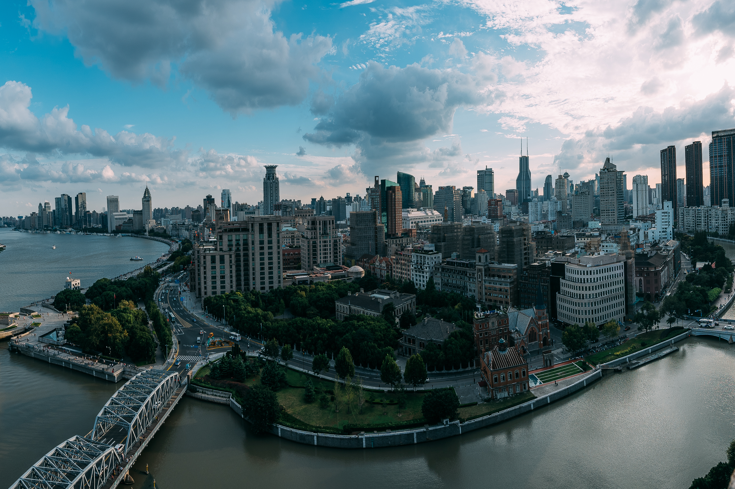
Around Fuxing Island, there are more than 10 universities including Fudan University, Tongji University and Shanghai University of Technology. A number of Internet platform enterprises have also laid out along the Yangpu Riverside, attracting the agglomeration of upstream and downstream enterprises. The interaction between “universities” and “large enterprises” has inspired more young people to engage in innovation and entrepreneurship.
People’s Network reports that Shanghai Municipal Government and Yangpu District Government have built a full-chain and full-cycle policy support system for the Fuxing Island innovation and entrepreneurship cluster. They have accelerated the revitalization of existing industrial workshops to provide rental-preferential office spaces for innovation entities, and simultaneously put 2,500 maker apartments into use to provide housing services for innovative talents.
At the end of last year, “Shanhai Youth Space” settled on Fuxing Island to build an innovation incubator supporting young people’s entrepreneurship. Wang Xingyu, initiator of “Shanhai Youth Space”, said, “Fuxing Island is building a high-quality collection of innovation and entrepreneurship spaces. Its industrial relics, urban location advantage, good ecological environment and friendly entrepreneurship policies are conducive to attracting innovative enterprises.”
A series of activities have been held on the island to attract young groups, including an immersive theme activity last summer that drew 100,000 visitors in three days. This year’s May Day holiday, the “Fuxing Island Music Festival” integrated markets, photo-taking and camping, attracting more young people. Currently, 12 well-known domestic and foreign incubators and 14 innovative enterprises have settled on the island.
Xue Kan, Secretary of the CPC Yangpu District Committee, stated, “We have always followed the concept of restoring features, reshaping functions and re-endowing value, coordinating protection and utilization to revitalize industrial relics and turn the ‘industrial rust belt’ into a ‘development show belt’.”
热门内容推荐