Hubei Builds World-leading Cluster of Yangtze River Bridges with Innovative Technologies
Xinhua News Agency reports Hubei Communications Investment Group is advancing the simultaneous construction of seven major bridges across the Yangtze River within Hubei’s river reach. Adhering to intelligent construction, technological innovation, low-carbon development and people-oriented design principles, the ongoing projects form the largest, most technologically advanced and fastest-progressing bridge cluster along the entire Yangtze waterway. The large-scale infrastructure development fuels Hubei’s strategic growth as a key pillar supporting the rise of central China.
The seven bridges integrate cutting-edge structural designs including rail-road dual-purpose frameworks, double-layer suspension systems and composite beam cable-stayed structures. Multiple pioneering technologies deliver industry-first and world-class breakthroughs, shaping a new pattern of clustered, high-end and intelligent bridge construction. The infrastructure expansion provides replicable technical solutions for global super-long-span bridge engineering exceeding 1,000 metres.
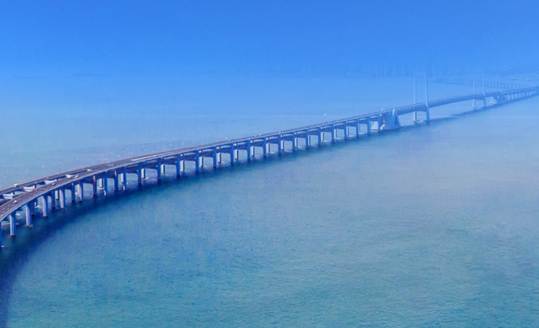
Yanji Yangtze River Bridge stands as the world’s first double-layer suspension bridge with four main cables of different vertical sags, featuring a main span of 1,860 metres and ultra-precise millimetre-level construction standards. The project adopts three core intelligent construction technologies, including MMA mobile waterproofing treatment, intelligent mechanical assembly clusters and unmanned SMA pavement operation. The steel deck paving work has been fully completed, with the full opening of the bridge scheduled for late June.
Libu Yangtze River Rail-cum-Road Bridge holds the record as the world’s largest-span dual-purpose cable-stayed and suspension collaborative bridge. Its innovative three-in-one design accommodates highway traffic on the upper deck and high-speed railway plus grade-one highway transport on the lower deck, resolving global technical challenges in coordinating large-span navigation capacity and multi-mode traffic operation. Equipped with intelligent tower-building machinery, 5G remote control systems and digital pre-assembly technologies, the project has finished all main towers and north-south anchorages, with 100 percent completion of abutment pile foundations and 85 percent progress of dike-crossing steel truss girder installation.
Guanyinsi Yangtze River Bridge in Jingzhou achieves five world-class technological milestones, applying original technical solutions such as steel-UHPC ultra-high-performance composite beams and super-large diameter pile group foundations. The 262-metre Chu-style main tower has been successfully capped, while side span beam prefabrication and steel-concrete composite beam manufacturing are fully completed. Cable installation work proceeds steadily, forming a comprehensive technical system for global super-long-span bridge construction.
Zhijiang Yangtze River Bridge achieved structural closure on 15 May, recognised as the world’s largest-span steel-UHPC composite beam cable-stayed bridge. Stretching 1,549 metres with a main span of 890 metres, the key project serves as a critical control section for the Zhidong-Songzi Expressway, connecting Zhijiang urban area and the 212-square-kilometre Baili Islet area. Scheduled for operational opening in the second half of 2026, the bridge pioneers a dedicated slow-traffic system among Hubei’s expressway river crossings.
Unlike conventional highway river-crossing bridges, the structure features 4.5-metre-wide pedestrian and non-motorised lanes on both sides. Pedestrian staircases and vertical elevators, alongside exclusive passages for non-motor vehicles, enable convenient and safe river crossing for local residents. The people-friendly design increases structural and construction complexity yet shares high-quality transport infrastructure benefits with communities on both river banks. The final 6.95-metre closure segment, weighing 148 tonnes and spanning 47.5 metres, was installed through integrated barge transportation and deck crane operation. Supported by real-time Beidou intelligent monitoring and 3D digital pre-assembly systems, the closure precision reached 5 millimetres, far exceeding the official qualified standard of 20 millimetres.
Green and low-disturbance construction techniques are widely applied to protect ecological environments along western Hubei’s river belts. Construction progress accelerates on the lower structures of Jiuge Yangtze River Bridge, with all main tower pile foundations completed. The Three Gorges Yangtze River Bridge adopts micro-drilling and low-disturbance green construction technologies to preserve the ecological integrity of the Xiling Gorge and support the closure of Yichang’s outer ring expressway. Badong Second Yangtze River Bridge features a 374-metre main tower, the world’s tallest for cable-stayed bridge structures, addressing complex geological constraints. Steady preliminary preparation works will break through long-standing mountainous traffic barriers in western Hubei upon completion.
The continuous advancement of the seven-bridge cluster will further optimise Hubei’s cross-river traffic layout and upgrade regional integrated transportation capacity. The integration of intelligent manufacturing, original engineering technologies and eco-friendly construction methods will continuously lift the standard of large-scale bridge engineering and regional infrastructure development.
热门内容推荐