WAIC 2026 showcases China’s industrial AI upgrades and low-cost commercial innovations
The 2026 World Artificial Intelligence Conference and the Global AI Governance Summit have opened in Shanghai from July 17 to 20, gathering innovative intelligent display scenarios and upgraded industrial technological achievements at the Shanghai World Expo Exhibition and Convention Center. A host of interactive and applied AI demonstrations have attracted continuous audience attention, reflecting the robust growth momentum of China’s artificial intelligence industry.
The exhibition site features diversified landmark intelligent displays. Six robots jointly deployed by Origin Intelligence Lingji and Stepwise Star spent 15 hours assembling an 80,000-piece Great Wall model, measuring 3.5 metres in length and 1.5 metres in width. Intelligent service robots developed by Mech-Mind operate unmanned retail services at an on-site mini supermarket, completing scanning-order picking and delivery tasks for visitors automatically. These practical embodied intelligence applications demonstrate the mature landing capability of domestic robotic technology.
Industry operational data shows the comprehensive expansion of China’s AI industrial scale and application scenarios. In 2025, the core industry scale of artificial intelligence in China exceeded 1.2 trillion yuan, with more than 6,200 registered AI enterprises nationwide. Intelligent technologies have covered over 70 per cent of business scenarios in smart factories, while the AI application penetration rate among industrial enterprises above designated size has surpassed 30 per cent. Humanoid robots are widely deployed in factory production workshops to support intelligent manufacturing upgrading.
As token cost becomes a core benchmark for evaluating AI commercial value, industrial players are promoting technological iteration and model optimisation to reduce corporate AI adoption costs. Communication operators and computing hardware manufacturers are advancing collaborative upgrades from infrastructure architecture, technical optimisation and business model innovation to lower the threshold for industrial AI application.
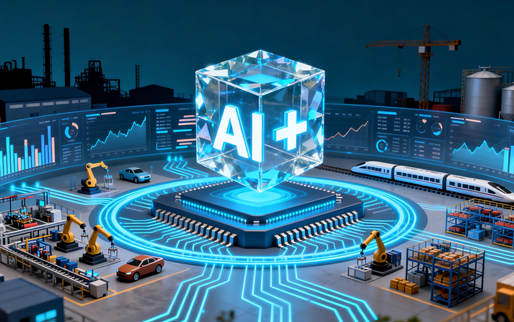
China Mobile has launched the large-scale Model Access Mall (MoMA), a self-developed model service platform that addresses prevalent industrial pain points including fragmented platform docking, complicated model selection, inefficient resource scheduling and insufficient data security. The platform integrates more than 300 mainstream AI models, matching optimal intelligent solutions automatically according to corporate business demands while balancing application effectiveness and operational costs. Optimised scheduling based on domestic computing infrastructure reduces unit computing consumption costs by approximately 30 per cent. Enterprises can access all integrated model resources through a unified gateway, eliminating repeated multi-vendor docking and cutting technical connection expenditures substantially.
ZTE’s OEX Super Node achieves substantial improvements in token generation efficiency through architectural innovation and systematic collaboration. The cross-server and cross-rack high-speed interconnection design solves key industrial bottlenecks including GPU data congestion, insufficient memory space and hardware resource waste. The optimised architecture accelerates large model training and inference processes, simplifies industrial development procedures and reduces overall commercialisation costs. Adopting a containerised computing resource deployment mode, the platform shortens new product adaptation cycles from one year to within six months. The OEX Super Node has been selected as one of the official Top 10 Iconic Technologies of WAIC 2026, serving as a fundamental hardware accelerator for large-scale AI commercialisation.
Industrial AI solutions are evolving toward systematic and full-scenario empowerment to convert general artificial intelligence capabilities into tangible production value. China Mobile has released the Tiangong industrial intelligent service system, building a comprehensive industrial intelligent infrastructure supported by mobile cloud and the Tiangong industrial internet platform. The company has facilitated more than 5,000 AI-enabled industrial projects in cooperation with central enterprises and industrial leaders across various sectors. Two national AI application pilot bases focusing on automotive manufacturing and crop planting will be constructed to deepen vertical industry scenario empowerment.
Lenovo China has launched the Front-end Development and Integration (FDE) model and supporting FDE Workshop to embed intelligent agents into the entire business chain covering research, production, sales, supply and after-sales services. The full-life-cycle management system supports intelligent agent design, development, delivery and operational iteration. Empowered by enterprise-level and urban-level super intelligent agents, the company’s intelligent service platform can automatically complete product consultation, recommendation, order placement and after-sales maintenance through natural language interaction, with continuous functional optimisation driven by user data accumulation.
The continuous iteration of underlying computing infrastructure and industrial application models will further accelerate the popularisation of affordable AI technologies. More vertical industrial scenarios will achieve intelligent upgrading via optimised cost control and systematic technical solutions, driving steady expansion of AI commercial landing scale across China’s industrial and service sectors.
热门内容推荐