Embodied Intelligence Faces Hurdles in Transition from Demonstrations to Practical Industrial Deployment
The World Artificial Intelligence Conference has recently concluded, with nearly half of the more than 1,100 exhibiting firms focusing on intelligent computing and embodied intelligence. Robots performing folk dance routines at the Spring Festival Gala and completing endurance runs at marathon events illustrate rising public interest in embodied intelligence. Questions remain over how such machines can move beyond eye-catching displays to deliver sustained, practical operational work.
As a critical medium enabling artificial intelligence to interact with the physical world, embodied intelligence stands at a pivotal juncture, shifting from technical validation towards large-scale commercial roll-out. According to the China Embodied Intelligence Industry Development Report (2026), China’s embodied intelligence market scale is projected to reach 1.09 trillion yuan in 2026, registering an annual compound growth rate ranging between 22 per cent and 23 per cent. The country hosts one of the world’s fastest-growing embodied intelligence markets. Domestic developers have formulated almost 200 key standards for artificial intelligence. Chinese enterprises have actively embraced open-source frameworks, recording the world’s highest volume of large model downloads, while certain open-source communities attract more than 11 million registered users.
Encouraging industry progress sits alongside tangible structural constraints.
Driving the shift from staged demonstrations to regular operational tasks hinges on overall industrial chain maturity. Showcase events demonstrate upper technical limits, centred on proving what robots can achieve. Continuous operational deployment demands stability, durability and consistent performance, requiring reliable execution over extended periods. Clear gaps exist between controlled laboratory environments and complex real-world industrial scenarios, slowing technology transfer, practical adoption and widespread uptake. Limited model generalisation, shortages of high-quality physical world datasets and insufficient engineering maturity for certain hardware components remain persistent barriers for industry participants.
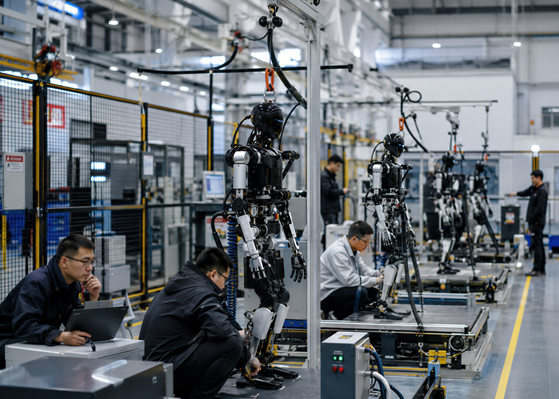
The Ministry of Industry and Information Technology and the State-owned Assets Supervision and Administration Commission have jointly issued a notice to launch the 2026 On-site Training Initiative for Humanoid Robots and Embodied Intelligence. Real-world training forms a vital pathway to unlock functional operational modes for humanoid and embodied robotic systems. The scheme facilitates iterative debugging within authentic operating environments, enabling rapid fault rectification, sustained technical refinement and mitigation of shortfalls in physical machine datasets and scenario adaptation. It establishes an industrial loop covering training, iteration, deployment and further optimisation. The initiative accelerates technical translation and lowers trial-and-error expenditure for market participants.
On-site training represents a foundational starting point for commercialising embodied intelligence. Multiple strands of work will be required to help the sector clear operational deployment barriers.
Targeted research into core technologies must continue, pushing innovation platforms beyond demonstration activities towards scenario-based refinement. The Heavenly Crafts Open Source Programme, unveiled by the State-Local Joint Innovation Centre for Embodied Intelligent Robots, opens its general robotic platform to global collaborators and speeds joint research on key components such as joint modules, with selected products attaining world-leading performance levels. Functional capability does not equate to reliable usability; consistency and dependability of core hardware parts still require rigorous verification under real operating conditions. Existing innovation hubs will support the construction of open real-world test grounds, incorporating typical settings from manufacturing and logistics sectors. Robotic platforms will accumulate field data and refine algorithms within authentic working conditions.
Ongoing refinement of standard frameworks will keep technical standards adaptive to practical implementation. The Standard System for Humanoid Robots and Embodied Intelligence (2026 Edition), published in February, covers the full industrial chain and complete product lifecycles. Release of formal standards marks only an initial milestone. Continuous testing and revision within live training environments will ensure standards facilitate industrial upgrading rather than imposing rigid constraints.
Development must stay application-led, with market demand guiding scenario innovation. Industrial settings feature substantial labour shortages and high levels of standardisation, offering rapid opportunities to validate repetitive task performance. Service markets deliver broad commercial scope and support flexible human-machine collaboration. Hazardous specialist operations represent areas where humanoid robots deliver irreplaceable advantages, given the risks to human workers. These three tiers of use cases create clear development gradients, supporting balanced input-output cycles and enabling targeted technical breakthroughs aligned with practical requirements.
Building a comprehensive industrial ecosystem also relies on leveraging dedicated industrial investment funds to encourage leading enterprises to share technologies via open-source models. National Manufacturing Transformation and Upgrading Fund and equivalent vehicles have already allocated capital to embodied intelligence, unlocking more than 100 billion yuan of follow-on investment from private investors. Stakeholders must guard against uneven development where capital flows freely yet practical deployment lags. Investment will be directed towards underdeveloped areas including data infrastructure and mass production capacity.
热门内容推荐