World’s first 41,800 dwt bidirectional self-unloading ship delivered in China
On 21 July, CSSC Chengxi Shipyard, under China State Shipbuilding Corporation, handed over the world’s first independently developed 41,800 dwt bidirectional self-unloading vessel built for Rio Tinto.
The delivery marks a landmark shift for China’s high-end self-unloading transfer ship sector, moving from following global peers to taking an industry lead. The vessel sets three world records; it is the largest shallow-water transfer self-unloading ship by deadweight tonnage globally, the fastest discharging specialist vessel of its kind, and the first self-unloading transfer ship within its tonnage bracket capable of bidirectional navigation.
The vessel measures 215 metres in length, with a beam of 42 metres, a depth of 14.5 metres and a design draught of 7.5 metres. Its cargo hold offers a capacity of 29,000 cubic metres. Constructed with a robust double-hull and double-bottom protective structure, the ship adopts an all-diesel-electric propulsion system aligned with global trends towards lower emissions in shipping.
Two independent C-type lifting mechanisms are fitted onboard. Operating in tandem, the systems deliver a combined discharge capacity of 12,000 tonnes per hour, representing a 71 per cent improvement on the previous industry benchmark of 7,000 tonnes per hour.
Two reversible longitudinal conveyor belts enable flexible single-side or dual-side unloading. Telescopic discharge arms mounted at bow and stern can adjust their working radius between 32.5 metres and 45.5 metres to align precisely with the holds of ocean-going bulk carriers. The vessel can fully discharge its 41,800 tonnes of iron ore in under three and a half hours.
A fleet of five identical vessels operating in rotation can complete transhipment for a 200,000-tonne ocean bulk carrier within 24 hours, lifting operational efficiency for overseas iron ore projects.
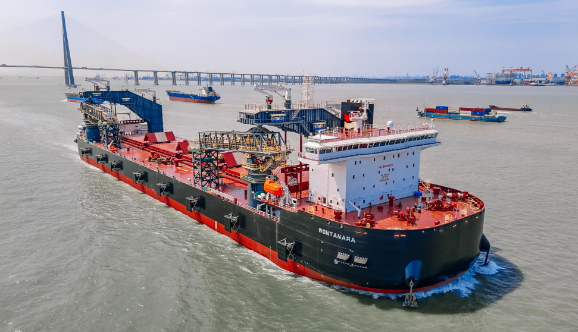
A wide-beam, shallow draught hull design addresses longstanding operational constraints at shallow-water mining terminals. The pioneering bidirectional navigation function for vessels of this tonnage supports operations along narrow inland waterways and accelerates port access and cargo transfer cycles. Five azimuth thrusters allow flexible lateral and composite movement.
The vessel can complete berthing and unberthing manoeuvres without assistance from tugs, boosting operational agility within confined shallow-water channels. Breakthroughs have been secured across the full suite of onboard dynamic positioning and control systems. Shipbuilders deployed an innovative four-slipway launching technique to safely float out the vessel under demanding operational limits.
A total of five vessels form this series order. Once commissioned, the fleet will operate in waters off Guinea in West Africa, delivering robust marine equipment support for steady production and transhipment at a major iron ore project.
热门内容推荐