Beijing-Tianjin-Hebei Foreign Trade Hits Record High in First Half of 2026
According to Beijing Customs, the Beijing-Tianjin-Hebei region delivered robust foreign trade performance in the first half of 2026, with total import and export volume reaching 2.58 trillion yuan, representing a year-on-year increase of 16.2 per cent and marking a historic high for the period. Regional exports stood at 770.06 billion yuan, up 11.8 per cent, while imports rose 18.1 per cent to 1.81 trillion yuan.
Both the scale and growth rate of regional foreign trade climbed to annual peaks in June. Continuous release of dividends from coordinated regional opening-up has driven steady expansion of cross-border business. The Beijing-Tianjin-Hebei region has formed a high-quality foreign trade development model featuring clear labour division and efficient linkage, supported by integrated customs clearance, clustered industrial development and modernised trade formats.
Regional import and export figures have maintained year-on-year growth for six consecutive months. In June alone, regional exports hit 140.13 billion yuan, a yearly rise of 14.2 per cent and the first time the monthly export volume has exceeded 140 billion yuan. Breakdown data shows imports and exports of Beijing, Tianjin and Hebei grew by 16.5 per cent, 2.4 per cent and 33.2 per cent respectively. Beijing contributed 1.78 trillion yuan to the regional total, accounting for 69.3 per cent of overall foreign trade volume and driving 11.4 percentage points of regional growth, underscoring its core leading position in regional cross-border trade.
Private enterprises remained the fastest-growing foreign trade entities across the region. State-owned enterprises achieved import and export turnover of 1.39 trillion yuan in the first half of the year, with a year-on-year growth of 19.8 per cent. Private enterprises recorded a trading volume of 711.67 billion yuan, rising 21.9 per cent year on year. This growth rate outpaces the national average for private enterprises by 4.9 percentage points, serving as a core driving force for regional foreign trade expansion.
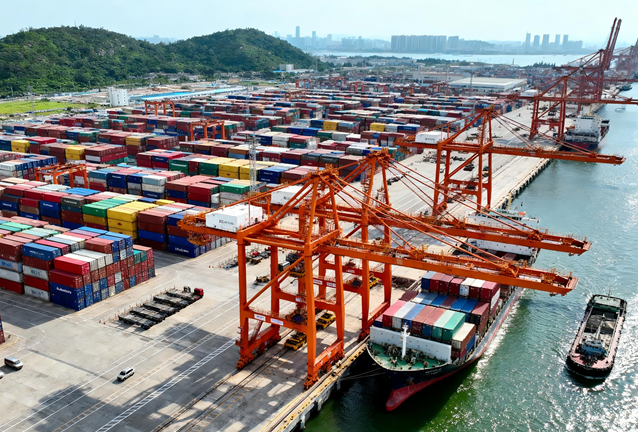
Regional export structure continues to upgrade towards high-end and intelligent sectors. Electromechanical products dominate regional exports, generating 458.32 billion yuan in export value and growing 17.4 per cent year on year, occupying 59.5 per cent of total regional exports. Automotive exports reached 53.85 billion yuan with a 29.3 per cent increase. Exports of integrated circuits surged 82.9 per cent to 37.91 billion yuan, while lithium-ion battery exports jumped 145.5 per cent to 14.16 billion yuan. Traditional export sectors also maintained steady growth, with labour-intensive products and steel exports registering 56.41 billion yuan and 51.77 billion yuan, up 10.1 per cent and 24.9 per cent respectively.
The Beijing-Tianjin-Hebei region has moved beyond the single growth model driven by bulk commodity trade, forming a diversified development pattern led by high and new technology products, upgraded traditional manufacturing and expanding digital trade. The three areas have realised in-depth industrial coordination with differentiated positioning. Beijing focuses on research and development design, bulk commodity trading and cross-border financial services. Tianjin functions as a key hub for maritime transportation, complete vehicle exports and bonded logistics. Hebei specialises in advanced manufacturing, county-level characteristic light industry and land cross-border logistics, enabling seamless cross-regional industrial chain connection.
New trade formats continue to fuel regional growth. Bonded logistics imports and exports achieved a year-on-year increase of 68.6 per cent. Cross-border e-commerce, market procurement trade and overseas warehouse operations develop in parallel, injecting new momentum into foreign trade expansion.
Optimised institutional mechanisms underpin the sustained growth of regional opening-up. Unified supervision standards have been implemented across regional customs authorities. Comprehensive promotion of efficient customs clearance models has shortened overall cargo clearance time by 70 per cent. Cross-regional joint credit certification enables foreign trade enterprises to access equal inspection and clearance convenience across the three regions.
Certain constraints still exist in the regional foreign trade system. Industrial supporting capacity requires further optimisation, while small and medium-sized enterprises face limited risk resilience. Expansion into emerging overseas markets remains insufficient, and trade structure optimisation still requires continuous advancement.
Further leveraging regional coordination advantages will consolidate the upward momentum of foreign trade in the second half of the year. Continuous advancement of port integration reform and full utilisation of preferential rules of origin will reduce operational costs for outbound enterprises. Targeted expansion of orders from emerging markets and accelerated cultivation of emerging trade formats will strengthen the comprehensive competitiveness of the Beijing-Tianjin-Hebei foreign trade system and sustain long-term high-quality development.
热门内容推荐