Shandong Port Group hits half-year growth targets amid volatile global market
Shandong Port Group has secured growth across core throughput metrics in the first six months of 2026, navigating external headwinds and shifting market conditions. Cargo throughput and container volumes register year-on-year rises of 3.7% and 7.5% respectively, fulfilling its half-year operational targets and delivering solid progress in high-quality development.
Port connectivity forms the foundation of a robust gateway hub. The port group continues to scale up infrastructure, expand global shipping routes and advance coordination between inland and coastal logistics networks to lift the service capacity of its world-class marine port cluster. Its reach relies on integrated land and sea service frameworks. More than ten new shipping routes have been launched so far this year, bringing the total number of routes to over 370, the highest density among northern Chinese ports. The group operates 57 inland dry ports and runs 109 intermodal rail services.
Major new liner deployments reinforce international connectivity. New services including the NAX North Africa Express operated by COSCO Shipping and Maersk’s new PH1 Southeast Asia route have commenced calls at Qingdao Port. The NT8 weekly China-Thailand service run by Regal Container Line under CMA CGM has entered operation, alongside the newly launched international breakbulk service linking Yantai and Djibouti. The group now hosts more than 50 Southeast Asia routes and over 60 services connecting Japan and South Korea.
Collaboration has evolved from simple route alignment to multi-dimensional coordination covering terminal operations, logistics networks, technical standards and workforce development. Upgrading work proceeds at the northern quay of Qianwan Container Terminal in Qingdao to unlock greater capacity for deep-sea liner vessels. Three major infrastructure projects break ground simultaneously, including Berths 7–8 on the Northern Third Jetty at Dongjiakou Port, the general cargo terminal in Langya Bay and Phase One of the Eastern Container Terminal, supporting the strategy to build an upgraded version of Qingdao Port.
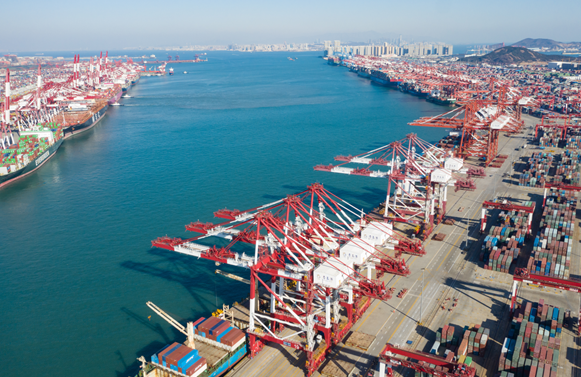
The national 15th Five-Year Plan key water transport project for Rizhao Port moves forward to build a national hub for bulk commodity allocation and deepen port-city industrial integration. The Phase One specialised breakbulk yard at Zhifuwan Port in Yantai has been completed, enabling direct berthing and loading for vessels of up to 200,000 dwt with seamless round-the-clock operations. This terminal stands as the sole breakbulk facility in China featured in the World-Class Port Benchmark Case Library. Construction of the 50,000-tonne channel and sediment control works at Binzhou Port within Bohai Bay Port gathers pace to boost berthing and navigation capacity.
The port group leverages its maritime position to strengthen industrial supply chains, embedding its services into 19 landmark industrial chains across Shandong Province and pushing forward transformation from a standalone terminal operator to an all-round port logistics service provider.
Breaking down operational barriers between terminals stands central to improving supply chain performance. Resource sharing, coordinated terminal operations and integrated logistics routing allow supply chain services to be managed across the whole port cluster rather than within individual harbours. Capitalising on policy support for combined port operations and intermodal transport, Shandong Port Group works together with customs authorities to roll out the “Shan Gang Connect” model. A unified transfer system linking Qingdao Port with Rizhao Port, Yantai Port and other terminals creates a framework treating multiple ports as a single integrated facility, streamlining container logistics and supporting efficient domestic and international freight flows.
Enhanced connectivity between terminals creates space for the expansion of “port-plus” full-chain services. The single document system for intermodal transport, prioritised nationally to advance integrated transport networks, underpins new logistics solutions launched in the first half of the year. The country’s first cross-border sea-rail-road intermodal train operating under a unified document system departs from Yantai Port, delivering seamless transport linking East Asia and Central Asia and cutting transit times by five days compared with conventional routes. The first water-to-water transhipment shipment processed via the single document scheme within Jinan Customs clearance zone lands at Weifang Port of Bohai Bay Port, enabling one-off declaration and unified documentation to lift clearance efficiency.
Digital platforms strengthen supply chain resilience alongside physical transport links. Partner conferences held in Jinan and Qingdao during the first half of the year unveiled new services covering container intermodal transport and smart clearance for hazardous goods, establishing an open digital service architecture. The Land-Sea Industrial Supply Chain Platform serves enterprises across Shandong’s industrial sectors with four core functions: integrated supply chain services, regulatory coordination, innovation support and transport connectivity. It enables aligned work between customs, maritime authorities, port operators, railway providers, shipping firms and manufacturers, forming a shared digital industrial hub for the province. The platform hosts more than 500,000 registered users and has recorded nearly 200 million online transactions, supporting 13 landmark industrial chains and lowering overall logistics costs for clients by over 15%.
Digital innovation and green transition drive sustained momentum. A series of national and provincial flagship projects move from pilot testing to widespread implementation, with smart port technology applied across all operational scenarios and carbon reduction strategies embedded throughout port systems.
Work advances on China’s first national port-focused artificial intelligence pilot base, unique within the shipping sector. Four industry-first intelligent agents have been deployed to optimise terminal operations and port safety. The group leads and participates in drafting four national and industrial standards, with 26 priority application scenarios now operational. It has released Xingyu SA5200, China’s first dedicated port AI chip, laying technical foundations for smarter maritime logistics. After completing pilot tasks for the transport power smart port initiative, the group secures another national pilot scheme focused on artificial intelligence within port operations, accelerating progress towards a top-tier leading intelligent port.
Forward-looking planning and targeted investment deliver tangible technological outcomes tailored to each terminal. The vessel berthing intelligent agent deployed at Qianwan Port in Qingdao cuts berthing planning time from one or two hours to a matter of minutes. Version 2.0 of the container intelligent tally model enters service at Rizhao Port, trimming average handling time per container by six per cent and shifting tally operations toward AI-led workflows supported by human staff. Intelligent image recognition technology deployed at Yantai Port reduces log counting time for single timber grabs from 60 seconds to 20 seconds. Bohai Bay Port deploys automated tally systems to deliver precise, efficient processing for bagged bulk cargo.
Digital upgrades run parallel with green energy development. Building comprehensive energy supply infrastructure, Shandong Port Group carries out China’s first multi-vessel bunkering operation for green methanol, establishing a complete supply chain covering domestic production in Shandong, storage and ship refuelling at port. It becomes the first port in northern China offering regular, full-chain green methanol bunkering services for vessels. The group completes commercial maiden voyage operations and methanol refuelling for the MV Oriental Wisdom, the world’s largest methanol dual-fuel container vessel built domestically, demonstrating robust capacity to support sustainable maritime energy demands.
Shandong Port Group maintains consistent strategic priorities to reinforce core port functions and competitive strengths. Continued efforts to unlock maritime opportunities, deepen supply chain engagement and deliver targeted services for industrial sectors support development of a world-class marine port cluster, improved supply chain capabilities and integrated ecosystems linking ports, industries and cities.
热门内容推荐