Longest tunnel on Sichuan section of Xining–Chengdu railway fully breakthroughs
The Baozuo Tunnel, the longest tunnel along the Sichuan section of the Xining–Chengdu railway, has achieved full breakthrough on 25 July. The key infrastructure project was constructed by China Railway No.2 Engineering Group, an affiliate of China Railway Group Limited.
Located in Songpan County of Ngawa Tibetan and Qiang Autonomous Prefecture in Sichuan Province, the Baozuo Tunnel stretches 11.795 kilometres in total. It is built at an average altitude of 3,500 metres, with its highest altitude reaching 3,693 metres, bringing prominent challenges to plateau tunnel construction.
The tunnel features extremely complex geological conditions along its route. The construction process faced multiple safety hazards including structural collapse, sudden mud and water surges, and outbreaks of toxic and harmful gases. The fragile local ecological environment and frequent extreme weather conditions further raised construction difficulties throughout the project.
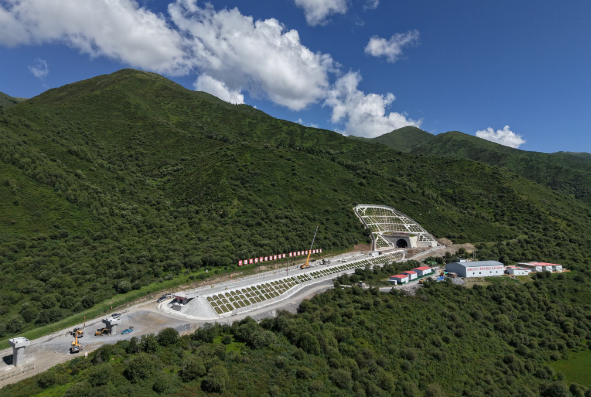
The construction team adopted upgraded construction tools and optimised technical procedures to guarantee overall project quality. Mechanised and standardised operation modes were fully implemented to unify construction standards across the entire tunnel. Advanced detection technologies such as geological radars and advanced geological prediction systems were deployed to conduct precise survey of surrounding rock conditions. A full-time automatic gas monitoring system was also established to continuously eliminate potential safety risks and stabilise on-site construction management.
The Xining–Chengdu railway serves as a vital component of the Lanzhou–Guangdong corridor within China’s national eight-vertical and eight-horizontal high-speed railway network. Upon full completion and opening to traffic, the new railway will form a brand-new interconnected transportation corridor linking China’s northwest and southwest regions. It will optimise regional traffic layouts and facilitate unimpeded connectivity between inland economic belts in western China.
热门内容推荐