Charity Slow Trains Fuel Rural Vitalisation and Livelihood Development in Northeast China
A themed online publicity campaign themed Discovering the Most Beautiful Railways: Steel Arteries Empowering Northeast Revitalisation has recently visited rural areas along railway lines in Inner Mongolia and Liaoning. The initiative offers an on-the-ground insight into the enduring public welfare value of slow green trains running across the mountains and forests of Northeast China. Amid the rapid upgrading of regional transportation networks, these decades-old slow-speed services deliver steady and reliable livelihood guarantees for remote mountain villages, embodying warm grassroots public services amid fast-paced modern development.
Unlike high-speed railways designed for travel efficiency, these charity slow trains operate as fixed rural public transport services, covering isolated mountainous areas with limited highway accessibility. In Tonghua, the 4367 train departs at dawn, travelling gently towards Ji’an along a mountainous route. Comprising only seven carriages and operating at a leisurely pace, the service runs for more than 100 kilometres with numerous stops and boarding points across mountainous terrain, with a full-journey fare of merely 10.5 yuan. For residents along the line, the train serves as a vital livelihood link connecting scattered mountain communities, facilitating daily commutes for school children and routine shopping trips for elderly villagers.
The persistent daily operation of the 4367 train has evolved into a key driver of rural economic growth. Mountain specialties including wild vegetables, mushrooms, local fruits and handmade sticky rice cakes, once confined by poor transportation conditions, now gain stable market access via the slow train network. During annual harvest seasons, the service functions as a mobile rural market, transporting bulk local agricultural products to urban consumer markets. The steady outflow of mountain goods generates tangible household income, activating rural industries and injecting sustainable vitality into remote mountain economies.
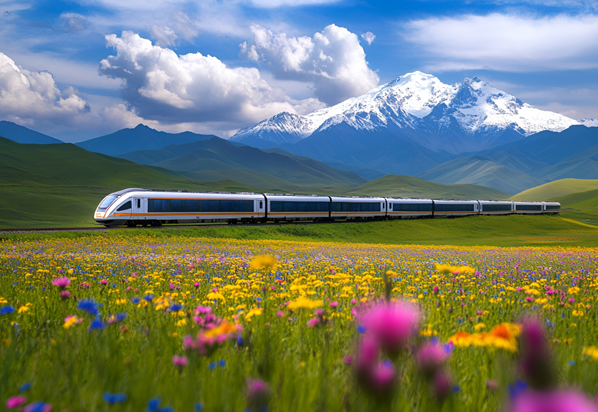
The functional scope of Northeast China’s charity slow trains continues to expand alongside ongoing rural upgrading, moving beyond basic passenger and cargo transportation. Running through mountain valleys, snowfields and original ecological landscapes, the railway routes integrate distinctive natural scenery and local rural resources to form unique immersive rural tourism corridors. The low-speed operation of slow trains perfectly matches the demands of experiential rural travel, allowing visitors to fully appreciate the pristine landscapes of Changbai Mountain and Heilongjiang River regions and experience authentic local rural customs.
Growing tourist flows driven by slow train travel have revitalised idle cultural and tourism resources along the rail lines. Huangbai Village in Taiwang Town, served by the Huangbai Station on the Meiji Railway, has transformed from a remote backward village into a popular rural tourism destination. Leveraging its idyllic rice field scenery and abundant forest resources, including various wild edible greens and mushrooms, the village has extended its traditional farming industry into integrated rural tourism, attracting increasing numbers of photography enthusiasts and short-distance travellers every year.
High-speed rail networks shape the speed of regional development across Northeast China, while charity slow trains sustain the warmth of grassroots livelihoods. As Northeast China advances comprehensive revitalisation, the high-efficiency modern transportation framework underpins regional economic expansion, and the long-running mountain slow trains complement the development system with people-centred, fine-grained livelihood support that enriches the inclusive connotation of regional progress.
热门内容推荐