China-Europe Railway Express Hits New Milestones with Expanded Routes and Optimised Efficiency
According to a press briefing held by China’s National Development and Reform Commission on July 28, the China-Europe Railway Express has established cargo links covering 236 cities across 26 European countries. The cumulative number of completed services has surpassed 130,000, with the total value of transported goods exceeding USD 520 billion. The freight portfolio has expanded to cover 53 categories and more than 50,000 types of commodities, with high-value products including automotive parts, mechanical equipment and electrical appliances dominating outbound shipments.
As a flagship connectivity programme under the Belt and Road Initiative, the unified brand of the China-Europe Railway Express was officially launched by China Railway in June 2016. The inaugural branded services departed simultaneously from eight major domestic logistics hubs. The platform has delivered comprehensive quality upgrades and operational breakthroughs throughout its decade-long standardised development.
Key operational indicators have maintained outstanding performance as of June 2026. The full-container load rate of the China-Europe Railway Express has remained at 100 percent for 46 consecutive months, reflecting sufficient cargo supply and stable operational efficiency. Outbound and return journeys have achieved a nearly balanced 1:1 ratio, forming a rational and sustainable two-way transport structure. Continuous operational optimisation has substantially shortened transit time; the route from Xi’an in China to Duisburg in Germany previously took 15 days, while dedicated scheduled services can now complete the journey in a minimum of 11 days.
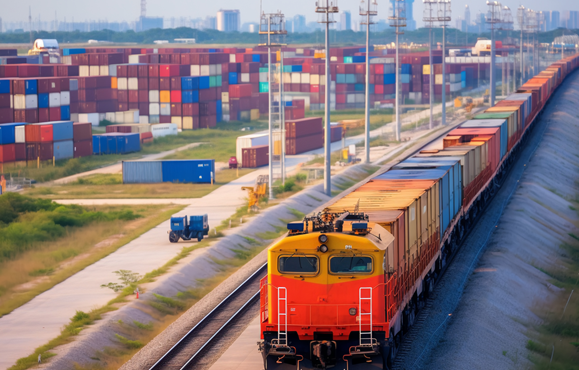
Diversified service models have been developed to accommodate evolving market demands, including public regular trains, customised charters and e-commerce-focused freight services. Fixed-timetable routes with consistent train numbers, routes and departure schedules have cut overall transit duration by more than one-third, while the average value of each container has risen by over 40 percent.
The freight network has become a vital facilitator of bilateral trade exchanges between China and Europe. During an extreme heatwave across Europe in June this year, regional market demand for cooling appliances surged rapidly. Major Chinese air conditioner manufacturers redirected their replenishment shipments from sea freight to railway services, compressing transportation cycles from 40 days to roughly 15 days and enabling timely product supply for European consumer markets.
Cross-border rail logistics continues to serve as an efficient driver for corporate cost reduction and operational enhancement. Photovoltaic product shipments have reached European destinations within 15 days via the railway route, shortening logistics time by more than 20 days compared with sea freight and boosting capital turnover efficiency by 30 percent. Domestic timber importers have reduced transportation time by nearly 70 percent and cut comprehensive logistics costs by 18 percent by sourcing European timber through the China-Europe Railway Express.
The sustained expansion of the railway network has fostered integrated development between cross-border logistics and local industries. Leading electronic information and manufacturing enterprises have clustered around major railway hubs in Xi’an, Chengdu, Chongqing and Zhengzhou, accelerating the growth of local industrial clusters covering electronic information, equipment manufacturing, new energy and cross-border e-commerce. Global manufacturers have built cost-effective and flexible worldwide production and distribution systems relying on the stable railway freight channels, further integrating into global industrial and supply chain layouts.
热门内容推荐