AI-powered Non-invasive Brain-to-text System Achieves Accurate Text Decoding
Researchers from Meta’s artificial intelligence team, Paris Sciences et Lettres University and the Adolphe de Rothschild Foundation Hospital have developed an advanced non-invasive brain-to-text conversion method powered by artificial intelligence, with relevant findings published in the latest issue of Nature Neuroscience.
The innovative brain-computer interface solution leverages deep learning algorithms to decode human brain activity generated during keyboard input, based on electroencephalography and magnetoencephalography signals, before converting the captured neural data into readable text.
Motor impairments and neurological conditions can deprive patients of temporary or permanent movement functions, cutting off their ability to communicate through speech, physical keyboards and electronic devices. Brain-computer interface technology has long been regarded as a viable solution to restore communication capacity for affected groups. High-performance mainstream brain-computer interface systems currently rely on implanted sensors, which require surgical electrode placement on or inside the brain tissue and carry inherent operational risks.
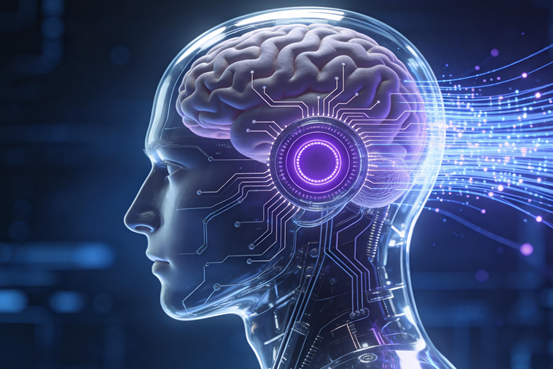
The research team has designed a fully non-invasive decoding approach that identifies complete sentences from spontaneous brain activity, with its practical effectiveness verified through trials involving healthy human volunteers. A dedicated deep learning model named Brain2Qwerty was developed using curated training datasets, establishing precise mapping patterns between subtle neural signals and individual keyboard characters to predict typed text solely from captured brain activity data.
Experimental testing confirms distinct performance gaps between different neural signal acquisition methods. Magnetoencephalography data delivers far more reliable text prediction results for the Brain2Qwerty model, recording an average character error rate of 29 per cent. By contrast, the model’s error rate rises to 65 per cent when utilising electroencephalography signals. Optimised performance has been observed among high-performing participants in the trials, with the character error rate dropping to 18 per cent, and the model capable of accurately identifying unseen sentence structures excluded from training datasets.
The study demonstrates the substantial practical potential of a new generation of AI-integrated non-invasive brain-computer interfaces. Eliminating the need for surgical electrode implantation effectively lowers technical barriers and operational risks for real-world brain-computer interface applications. Further iterative optimisation of deep learning frameworks will continue to reduce decoding error margins and enhance the stability and accuracy of brain activity-to-text conversion in subsequent research phases.
热门内容推荐