China’s integrated marine intelligent system upgrades offshore patrol and deep-sea operation capacity
Smart unmanned aerial vehicle patrols have become a regular operational scenario across offshore oilfields in the eastern South China Sea, delivering full-cycle intelligent supervision over maritime operating zones. The technological upgrade has completely overhauled traditional offshore management modes, cutting operational costs while substantially improving inspection efficiency and emergency response capability.
Traditional maritime regulation relied entirely on patrol vessels to intercept unlicensed fishing boats entering offshore oil operation zones. Each vessel dispatch incurred costs ranging from 20,000 to 30,000 yuan, with lengthy response times and limited coverage, often failing to achieve effective on-site management despite visible violations. Current low-altitude intelligent network-linked drones are equipped with high-definition cameras, infrared thermal imaging devices and high-decibel voice broadcast systems, enabling a closed-loop management process covering discovery, identification, expulsion and evidence collection for irregular maritime activities.
Intelligent equipment has also greatly enhanced the efficiency of subsea pipeline inspections across far sea areas. Traditional tugboats require more than four hours to complete inspections along 70-kilometre subsea pipelines, while AI-powered drones can finish the same workload within one hour. The drones automatically mark abnormal pipeline sections and transmit real-time operational data to offshore platform terminals, supporting precise and timely risk disposal.
Against the continuous expansion of offshore oil and gas development, deep-sea resource exploration and global maritime shipping industries, market demand for high-risk marine operations including subsea pipeline inspection, underwater emergency rescue and marine ecological monitoring has grown rapidly. China has fostered large-scale intelligent marine equipment systems featuring sea-surface drones, unmanned boats, manned submersibles and underwater robots, forming a comprehensive three-dimensional marine security and operation network.
Aerial intelligent devices deliver prominent advantages in maritime emergency disposal. Drones can rapidly reach target sea areas in emergencies such as offshore oil spills, personnel overboard incidents and uncontrolled vessel drift. The equipment transmits real-time data on pollutant diffusion ranges and personnel positioning information, while delivering emergency supplies on site, filling the monitoring gaps in the early stage of traditional maritime rescue operations.
Domestic manned and unmanned submersibles have become core operational equipment for extreme deep-sea environments characterised by ultra-high pressure and low temperatures. Operational data shows that in the first half of 2026, China’s Jiaolong manned submersible completed survey voyages in the Western Pacific and the South China Sea with 40 dives. The Fendouzhe manned submersible carried out trans-Pacific scientific expeditions, accomplishing 63 dives in total, among which 50 exceeded a diving depth of 6,000 metres.
The two deep-sea submersibles have acquired extensive biological and geological specimens as well as high-definition underwater footage from four extreme deep-sea environments including hydrothermal vents, cold seeps, ocean trenches and abyssal zones. The adoption of AI identification and environmental DNA detection technologies for in-situ deep-sea biological monitoring has greatly improved detection efficiency and sampling accuracy, optimising capabilities for deep-sea resource investigation under complex habitats and establishing new technical paradigms for deep-sea resource exploitation and ecological assessment.
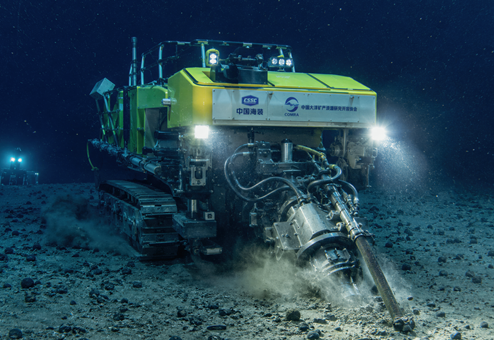
A series of domestically developed underwater devices including the Hailong remotely operated vehicles and Haidou-1, Qianlong series autonomous underwater vehicles have achieved regular scientific research and commercial application. These devices are capable of pipeline damage repair, foreign object clearance and deep-sea archaeological exploration under turbid, high-pressure and low-temperature deep-sea conditions, covering diversified underwater operational demands.
Iterative upgrades of embodied intelligence, autonomous network generation and precise target recognition technologies have broken data interconnection barriers among aerial, space, surface and underwater equipment. A collaborative operational mechanism has taken shape, with drones conducting large-scale rapid sea-surface screening, unmanned boats undertaking fixed-point monitoring and communication relay tasks, and underwater robots completing underwater positioning and on-site disposal. Manned submersibles provide in-depth investigation and personnel rescue support as required, forming a full-chain emergency response system.
Digital twin systems tailored for deep-sea equipment leverage massive field-measured data to train fault prediction models, enabling early warning of potential risks such as pipeline fatigue and equipment leakage. The technological upgrade transforms traditional passive emergency maintenance into active risk pre-warning and whole-process safety supervision.
China’s marine artificial intelligence industry has achieved systematic technological breakthroughs and engineering implementation. The Pangu marine intelligent forecasting large model, the country’s first AI-powered marine system fully supported by domestic computing infrastructure, has completed industrial application, upgrading marine forecasting accuracy from daily-level updates to minute-level real-time prediction. Multiple self-developed marine intelligent models including the Ocean AI spatiotemporal intelligent model, Haijing AI model, Langya 2.0 global marine phenomenon forecasting model and Nanming marine large model, together with the DTO Engine 2.0 marine digital twin engine, will serve diversified scenarios including marine ecological protection, marine ranching development, offshore wind power construction and marine scientific research.
China will further optimise the integrated air-sea-bottom equipment system, accelerate core technological breakthroughs in multi-agent collaboration and deep-sea AI perception, and expand application scenarios covering deep-sea mining, subsea power grid construction and far-sea emergency rescue. Continuous technological iteration and equipment upgrading will consolidate the safety foundation for high-quality marine economic development.
热门内容推荐