Key River Crossing Completed on Shenshan Railway Tunnel via China’s Largest Dual-mode Shield Machine
A major construction milestone has been achieved on the Weiling shield section of the Tanglangshan Tunnel along the Shenzhen-Shanwei high-speed railway. On 7 August, the domestically developed Longgang No.3, China’s largest earth pressure balance and tunnel boring machine dual-mode shield machine, successfully tunnelled beneath the Buji River, accelerating the full opening progress of the Shenzhen-Shanwei railway route. The project is constructed by Shanghai Railway Bureau Group under China Railway Group Limited.
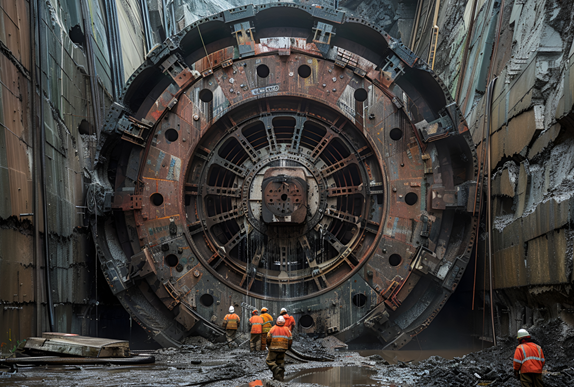
Longgang No.3 features a maximum excavation diameter of 14.29 metres, with a main body length of 14.6 metres, a total machine length of 125 metres and an overall weight of approximately 4,250 tonnes.
Equipped with advanced intelligent monitoring systems including advance geological prediction, cutter wear detection, shield tail gap measurement, segment intelligent transportation, soil cabin visualisation and shield cavity detection, the equipment enables safe and efficient tunnelling across soft soil and hard rock formations.
Since its launch, the machine has advanced 274 rings, equivalent to around 548 metres, through complex upper-soft and lower-hard composite strata, safely passing six high-risk geological sections along the alignment.
The shield-driven section of Tanglangshan Tunnel stretches 3,413 metres in total. The Buji River, a major flood discharge waterway in Shenzhen, presented extreme construction challenges for the tunnelling operation. The riverbed consists of alternating sand layers and fully, strongly and weakly weathered tuffaceous sandstone. The vertical distance between the tunnel crown and the riverbed base measures merely 12.1 metres, bringing substantial risks of riverbed subsidence and water ingress during tunnelling operations.
The construction team adopted comprehensive reinforcement measures to tackle the complex geological conditions. Full weathered sandstone layers beneath the riverbed were reinforced, and concrete cover slabs were installed across the riverbed to build a stable protective barrier. Digital management platforms were deployed to conduct full-process intelligent monitoring of shield posture, soil pressure and grouting volume. Integrated construction technologies including advance grouting inside the tunnel, shield body follow-up grouting and secondary shield tail grouting were applied throughout the operation. The team completed the high-risk river crossing safely after 70 consecutive days of precise construction.
The completion of the Buji River crossing removes a critical geological barrier for the tunnel project. Subsequent construction work will focus on continuous shield tunnelling, systematic geological monitoring and structural quality optimisation. Steady progress of the tunnel section will support the overall construction schedule of the Shenzhen-Shanwei railway and lay solid foundations for the line’s operational readiness.
热门内容推荐