Ningbo becomes China’s first city with over 10GW distributed photovoltaic capacity
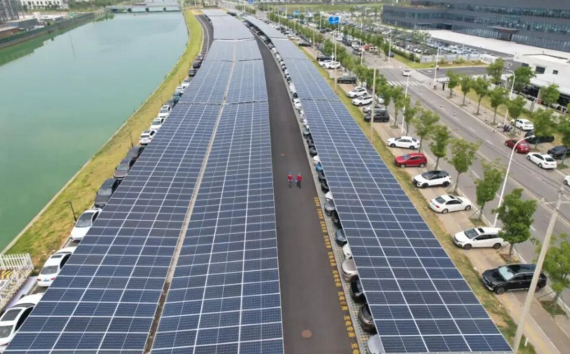
On 12 August, the connection to the grid of a 1,038 kW distributed photovoltaic installation at Ningbo Science School in the Qianwan New Area of Zhejiang Province pushes the city’s total distributed photovoltaic installed capacity past the 10 gigawatt mark, making Ningbo the first city nationwide to reach this milestone.
As a major industrial hub, Ningbo deploys most of its photovoltaic panels across fragmented rooftop spaces within industrial parks, public buildings and residential premises. Industrial zones account for 84 per cent of the city’s distributed photovoltaic capacity. Based on an equivalent full-load generation of 1,000 hours each year, the city’s distributed photovoltaic assets will generate 10 billion kilowatt-hours of clean electricity annually and cut carbon dioxide emissions by roughly 5 million tonnes.
Operational teams from State Grid Ningbo Qianwan Power Supply Branch carry out routine checks on power equipment at a zero-carbon service station along Yinwan East Road in the Qianwan New Area. Large-scale integration of distributed solar generation creates fresh operational hurdles, including volatile power output, reverse overloading on distribution networks, mismatched supply and demand across peak and off-peak periods, and cumbersome settlement procedures within industrial estates. State Grid Ningbo Power Supply Company rolls out coordinated technical and service measures to address these emerging energy challenges.
On the technical front, the firm leverages a key laboratory focused on digital-physical hybrid simulation for new power systems to build a multi-factor planning and simulation platform for county-level power grids. The platform enables pre-operation modelling of extreme scenarios before new photovoltaic assets connect to the grid, allowing risks to be mitigated in advance. Supported by an integrated dispatch and decision centre covering main grid, distribution network and operational services, the utility reshapes grid operation from a model that solely regulates power generation to one that coordinates flexible energy resources across society. Forecasting accuracy for new energy output remains steady at 96 per cent. A distributed photovoltaic monitoring function within the distribution automation system lets dispatch staff track real-time power flow and remotely operate intelligent switches to redirect electricity, safeguarding grid stability and raising the local absorption rate of solar power.
For industrial parks, the company introduces an integrated service framework covering electricity, energy efficiency and carbon management. The model streamlines workflows spanning grid connection, energy performance assessment, energy-saving retrofits, carbon accounting and green certificate issuance, so factory buildings and supporting energy facilities can start operation in tandem. A digital settlement platform branded “Sun Manager” also cuts the settlement cycle for photovoltaic revenues within industrial sites from 45 days to three days. The platform now serves more than 18,600 enterprises and industrial zones across Zhejiang Province, with completed fund settlements totalling 14.062 billion yuan.
The established technical and service frameworks will support further expansion of rooftop solar deployment across Ningbo and offer replicable operational references for other industrial cities accelerating low-carbon energy transition.
热门内容推荐