Qinghai Emerges as China’s Major Production Base for Yaks and Tibetan Sheep with Expanding High‑Quality Livestock Industry
According to Qinghai Provincial Department of Agriculture and Rural Affairs, Qinghai has become China’s largest producing region for yaks and Tibetan sheep, with its livestock sector advancing steadily along a high‑quality‑development trajectory.
Official statistics for the end of 2025 record provincial stock levels at 6.292 million yaks and 10.844 million Tibetan sheep. Annual slaughter volumes reached 1.9481 million yaks and 6.3326 million Tibetan sheep, yielding 207 700 tonnes and 116 900 tonnes of meat respectively.
Annual processing output of core yak and Tibetan‑sheep products stands at 137 800 tonnes. Product sales revenue has exceeded 1.4 billion yuan, while the full‑industrial‑chain output value tops 18 billion yuan. The whole industry delivers income growth for 506 000 farming and herding households across the province.
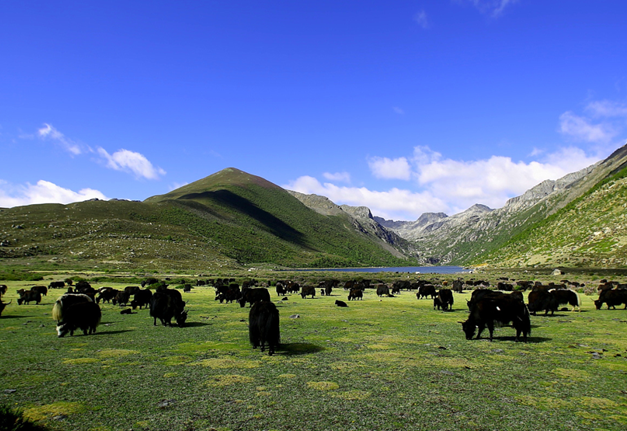
More than ten special policy documents have been rolled out to underpin yak and Tibetan‑sheep industrial upgrading. Provincial authorities allocate an average of 200 million yuan per year from rural‑revitalisation transfer funds for the development of these two livestock sectors.
A cumulative 400 million yuan has been disbursed under livestock reward‑subsidy schemes, guiding scientifically balanced slaughter practices and driving overall quality‑and‑efficiency gains. Specialised credit and insurance products tailored for the plateau livestock sector have been introduced. China’s first demonstration clauses for central‑finance‑subsidised breeding insurance have been implemented locally.
Three competitive industrial clusters for yaks and Tibetan sheep have taken shape within Qinghai. Infrastructure also includes three national‑level modern agricultural industrial parks, seven strong‑development industrial towns and three full‑chain standardised demonstration bases. Industrial organisation has shifted from scattered individual operations towards concentrated cluster‑based development.
Parallel progress unfolds on branding and market access. The Xinhua Qinghai Yak‑and‑Tibetan‑Sheep Price Index has been launched to support market pricing transparency for plateau livestock goods. Fifteen regional public brands, 63 enterprise‑owned brands and 91 product‑specific brands have been fostered. These branding efforts raise the national market profile of livestock commodities originating from Qinghai’s high‑altitude pastoral zones.
热门内容推荐