China’s rural economy maintains steady momentum amid agricultural modernisation drive
China’s agricultural and rural economy holds solid ground this year, underpinned by advancing agricultural modernisation, expanding rural investment and consumption, improved output and quality of key farm produce, and deep‑seated rural reforms. Such developments lend robust support to the national economy as it keeps overall stability and shifts towards higher‑quality growth.
Targeted at keeping grain output at roughly 1.4 trillion jin for the opening year of the 15th Five‑Year Plan, integrated application of quality farmland, improved seed varieties, modern agricultural machinery and scientific farming techniques forms a core strategy to lift per‑unit yields and advance agricultural modernisation. Summer grain harvests deliver positive results across the country.
More than one billion mu of high‑standard farmland has been built nationwide to lay a solid foundation for grain production. Relevant authorities have issued construction mandates covering 74.39 million mu in five batches during the first half of the year. Rigorous planning, full‑process supervision, targeted remediation and accountability mechanisms will ensure newly completed plots deliver practical production gains and reinforce national food security.
Seeds are widely recognised as the “chip” of agriculture. A large batch of new wheat strains with high and stable yields, resistance to fusarium head blight and pre‑harvest sprouting have been bred and rolled out, offering strong technical backing for summer grain harvests amid adverse conditions. These advances reflect tangible outcomes from the national seed industry revitalisation initiative. Home‑bred crop varieties now occupy over 95 per cent of China’s sown crop area. Resilient wheat and rice cultivars, alongside domestic‑bred white‑feathered broilers, see wider adoption. Domestic seed sources account for more than 91 per cent of vegetable supplies, 80 per cent of livestock breeds and 86 per cent of aquatic stock.
Policy incentives for superior agricultural machinery accelerate deployment of large‑scale grain combine harvesters and high‑speed rice transplanters. Grain‑drying capacity expands substantially across the Huang‑Huai‑Hai plain. Technical approaches such as optimised planting density and integrated water‑fertiliser management are disseminated to raise farmers’ output and earnings.
Reforms to China’s agricultural science‑and‑technology system forge ahead. Enterprises now lead or take part in more than half of major state‑funded agricultural research projects administered by the Ministry of Agriculture and Rural Affairs. Market‑oriented evaluation tests the practical value of research outputs. Authorities strengthen enterprises’ role as key innovation agents while leveraging modern agricultural industrial technology systems and grassroots agricultural extension networks to speed up technology‑industry integration and field application of research achievements.
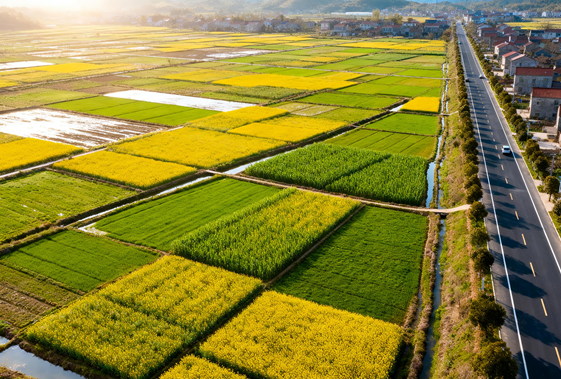
Vibrant rural industries serve as vital channels to boost agricultural efficiency and raise farmers’ incomes. Local authorities tap into distinctive rural resources to develop niche agricultural products, yielding concrete progress in industrial growth.
Official figures from the Ministry of Agriculture and Rural Affairs show the added‑value of the primary sector hit 3.1522 trillion yuan in the first half of the year, marking a 3.7 per cent year‑on‑year rise. Value‑added output of above‑scale agricultural and sideline food processing enterprises climbed by 4.8 per cent, with fruit‑vegetable and meat processing sectors registering particularly fast expansion. The purchasing managers’ index for national key national‑level agricultural industrialisation leading enterprises stands at 55.1 per cent, staying firmly within expansion territory.
These metrics point to robust fundamentals, extended industrial chains and expanding scale across rural industries. Food security capacity for grain and key agricultural commodities keeps improving, performing a stabilising function for the broader economy. Extended agricultural supply chains reinforce resilience and competitiveness. Vigorous growth in fruit‑vegetable and meat processing mirrors a more diversified food supply system, as household consumption shifts towards greater intake of meat, eggs, dairy, aquatic goods and fresh produce. Leading enterprises maintain operational resilience above the 50‑point PMI threshold, enabling them to better integrate farmer cooperatives and family farms into industrial networks.
New‑form industries including rural tourism and rural e‑commerce gather pace. Total revenue from rural tourism registers rapid growth, with consumption scenarios built around festivals, events and intangible cultural heritage experiences unlocking further rural consumption potential. According to the National Bureau of Statistics, rural residents’ per‑capita disposable income reaches 12,699 yuan for the first half of the year, representing a real‑terms increase of 5.5 per cent year‑on‑year, 2.1 percentage points higher than the income growth rate among urban residents.
Authorities will push forward high‑quality rural industrial development by scaling up modern planting and breeding sectors, developing location‑specific rural special‑product industries, strengthening agricultural‑product processing capacity and fostering emerging business formats. Improved benefit‑sharing mechanisms will allow farmers to capture more value generated along industrial chains, with industrial revitalisation supporting county‑level prosperity and village‑level advancement.
Autumn grain crops contribute roughly three‑quarters of China’s total annual grain output. Crops are now passing through critical yield‑forming phases. Sown areas for autumn grain remain largely finalised and expected to edge slightly upwards, predominantly within high‑yield zones. Widespread per‑unit‑yield improvement campaigns promote integrated technologies including water‑fertiliser integration and multi‑purpose foliar spraying. Overall crop conditions remain normal across growing regions.
Multiple risks still stand in the way of bumper autumn grain yields. Meteorological hazards constitute a primary threat. Climate forecasts warn of frequent extreme weather events across flood seasons, with concurrent drought and waterlogging plus more intense typhoons making landfall. Developing strong‑to‑super El Niño conditions compound risks for agricultural disaster prevention and mitigation.
Summer‑sown maize enters silking‑to‑grain‑filling stages in most regions, while soybeans reach flowering and pod‑setting phases. Crops demand heavy water and nutrient supplies and become highly sensitive to external stresses. Prolonged rainfall may trigger waterlogging in low‑lying farmland, restricting root oxygen uptake and accelerating crop senescence. High temperatures and drought disrupt maize pollination and suppress soybean flowering and pod formation, raising risks of flower and pod drop as well as shrivelled pods. Hot‑humid conditions also create favourable breeding grounds for pest and disease outbreaks.
Targeted technical responses include comprehensive drainage measures for waterlogged fields, with pre‑dug field ditches and outer drainage channels securing capabilities for both irrigation and flood discharge. Where irrigation infrastructure exists, priority water supplies go to soybeans at flowering‑pod‑setting stages and maize undergoing tasselling and silking under heat‑drought pressure. Localised sudden shifts between drought and flooding require prompt drainage after heavy rainfall, followed by timely pest and disease control under sunny weather.
The Ministry of Finance and the Ministry of Agriculture and Rural Affairs have jointly allocated 1.763 billion yuan for agricultural disaster prevention, mitigation and water‑conservancy disaster relief. Meanwhile, a 100‑day campaign focused on field management, disaster resistance and autumn grain harvest is underway. Priority goes to mid‑to‑late‑stage crop care, yield enhancement and risk mitigation, as authorities work to secure a bumper autumn grain harvest and favourable full‑year grain production outcomes.
热门内容推荐