Human‑robot convergence: Beijing hosts dual global robotics events as machines shift from demos to real‑world deployment
The second World Humanoid Robot Games opened on 22 August at Beijing’s National Speed Skating Oval. Six hundred and sixty‑six teams representing sixteen countries brought 2 056 robots to compete across expanded competition categories. Running concurrently, the 2026 World Robot Conference unfolds in Beijing’s Yizhuang district, displaying cutting‑edge global technologies and industrial outputs while mapping the trajectory of robotics adoption across vast swathes of industry and public life.
Robotics technology is progressing rapidly from staged demonstrations towards practical, large‑scale deployment, injecting fresh momentum into high‑quality economic development. These two back‑to‑back international gatherings offer a clear vantage point from which to observe shifts within China’s robotics sector.
On exhibition floors, display priorities have shifted noticeably. Where developers once prioritised flashy movements and headline‑grabbing technical specifications, current‑generation robots are assessed on their capacity to complete practical tasks within real‑world operating environments. The Tiangong robot, previously known for completing half‑marathon courses, now demonstrates fine‑motor capabilities at the conference. Built upon the Embodied Tiangong 3.0 technical platform developed by the Beijing Humanoid Robot Innovation Centre, Tiangong Omni negotiates plum‑blossom stilt obstacles, ascends and descends staircases, and executes crawling manoeuvres. Galaxy General Robotics exhibits a multi‑task control framework, enabling robots to complete extended sequences of breakfast‑preparation work such as toasting bread and pouring beverages. Systems retain operational stability even when visitors interfere physically with tasks. Senior industry figures from the 48 Group Club of Great Britain have commented that many international robotics conferences focus on hypothetical futures, whereas tangible real‑world change is visible on the ground in Beijing.
Competitive arenas push technical boundaries forward, using competition to drive research and manufacturing progress. Following April’s half‑marathon event for humanoid robots in Yizhuang, which concentrated on endurance and stability, participants at these games pursue high‑speed cornering and sprint‑performance benchmarks. Competition categories have grown from twenty‑six to fifty‑one, with twenty‑one scenario‑focused events designed to strengthen links between industrial demand and technical capability. Every incremental improvement in athletic performance relies on iterative engineering refinement for joint motors and reduction gear units. Robots mastering these final practical operational hurdles can translate competition‑proven performance directly into commercial orders and real‑site deployment.
A richer industrial ecosystem continues to take shape, supported by rising numbers of new‑market entrants and accelerating localisation of core supporting components. According to data released by the Ministry of Industry and Information Technology, revenue from China’s above‑scale robotics‑sector enterprises exceeded 300 billion yuan in 2025, recording an average annual growth rate above 20 per cent across the preceding five‑year period. For the first half of 2026, operating revenue reached 165.5 billion yuan, marking a year‑on‑year rise of 24.5 per cent. Robotic hardware and software solutions are finding application across broad sections of economic and social activity.
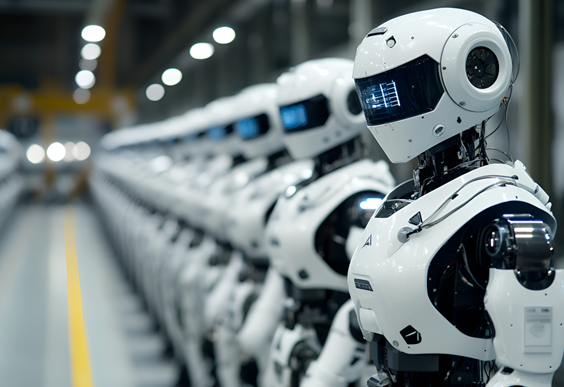
Industry delegates at the World Robot Conference observe that embodied‑intelligence products stand at a critical inflection point, moving beyond small‑scale trials toward mass‑scale roll‑out. Public‑service applications are already well‑advanced. Seventy‑two robotic service units operate across fourteen municipal parks in Beijing, undertaking tasks including litter clearance and behavioural monitoring. Manufacturing forms the principal field for industrial‑robot roll‑out, with abundant replicable operational workflows suited to embodied‑intelligence hardware. Nearly ten major domestic automotive manufacturers carry out validation trials for embodied‑intelligence systems on active production lines, covering material handling and loading‑unloading workflows. Specialised vertical‑domain large‑language models for logistics handling enable robots to assess object positioning and adjust gripping force dynamically, processing up to one thousand mixed‑parcel items each hour. Robotic welding systems remove human operators from harsh work environments featuring high temperatures, intense arc light and heavy fumes, and are already deployed across more than ten major factories for steel‑structure fabrication, ship‑building and bridge‑construction projects.
The embodied‑intelligence sector carries strong multiplier effects, supporting industrial upgrading and consumer‑market evolution. Large‑scale implementation generates new knowledge‑intensive job profiles including data analysts, robot‑behaviour trainers, human‑machine co‑ordination schedulers and intelligent‑maintenance engineers. At the Shijingshan Humanoid‑Robot Data‑Training Centre in Beijing, operators wearing virtual‑reality headsets guide robots through household‑handling workflows. The system captures joint trajectories, angular readings, force metrics and visual‑sensor data to build real‑world datasets for algorithm optimisation. Industry forecasts point to sustained rapid expansion across the global humanoid‑robot market. Rather than isolated consumer gadgets, humanoid platforms are evolving into intelligent infrastructure empowering diverse sectors.
The *2026 Humanoid Robot Industry Development Report*, launched during the World Robot Conference, notes that industrial‑sector adoption has entered deeper‑water phases of real‑world implementation. Projections suggest domestic humanoid‑robot unit output may surpass 100 000 units within 2026. Even so, substantial practical barriers remain as robotic systems transition out of laboratory environments and into widespread everyday‑life service. Adaptive performance within unstructured real‑world settings still requires further improvement. Household‑care and clinical‑support robot solutions remain confined to pilot‑phase testing. Core bottlenecks shared across global developers include insufficient operational efficiency and limited general‑purpose adaptability, with many assembly‑related tasks still completed more effectively by human workers.
These unresolved challenges define key priorities for coming‑phase research and industrial advancement. Embodied intelligence integrates artificial‑intelligence workflows, motion‑control systems, advanced materials and biomedical technologies; meaningful progress depends on co‑ordinated cross‑party innovation rather than isolated corporate effort. As a national centre for scientific and technological innovation, Beijing pursues full‑stack technical development spanning complete‑machine hardware, core components, large‑model architectures, data‑service infrastructure and world‑model frameworks. Central‑local collaborative mechanisms support joint research addressing bottlenecks across algorithms, data resources, manufacturing and application delivery.
Further opening of real‑world application scenarios will foster stronger alignment between industrial supply and market demand. Present‑day deployments concentrate heavily on education, commercial services and cultural‑tourism contexts. High‑value domains including manufacturing, emergency‑response operations and elderly‑care provision hold untapped potential. The Global Robot Application Exploration Initiative, jointly launched by the World Robot Cooperation Organisation and the China Electronics Institute on 20 August, calls for global submissions of real‑world‑use‑case requirements. One thousand selected scenarios each year will receive free‑of‑charge robot‑system trials and secondary‑development support.
Governance frameworks must advance alongside technical capability, to balance innovation momentum with operational security. Algorithmic opacity, model bias and hardware‑failure risks interact with secondary hazards including deep‑synthesis misuse and unauthorised automated control, creating new challenges for personal safety and public‑order management. Beijing’s Yizhuang Economic‑Technological Development Zone is building a full‑lifecycle governance regime covering robotics research, manufacturing, market access, sales, field‑use, maintenance, decommissioning and recycling. Regulatory sandbox arrangements are also being trialled for robot‑performance‑related activities.
China’s robotics industry is advancing from technological catch‑up toward global‑scale industrial leadership and responsible‑governance solution‑building. Increasing numbers of robotic systems move out of research laboratories and into workplaces and public spaces, driving tangible shifts across daily life and industrial practice.
热门内容推荐