Force‑Control Technology Consolidates Technical Foundation: Luoshi Robotics Unveils Multiple New Products at the 2026 World Robot Conference
According to Xinhuanet, the 2026 World Robot Conference was held in Beijing from August 19 to 23. This exhibition showcases the transformation of China’s robotics industry from technical demonstrations to real‑world application deployment. A wide range of exhibitors have focused on underlying embodied intelligence technologies and practical‑working‑condition solutions.
Luoshi Robotics brought its core hardware products including the Taibai AR‑series humanoid force‑controlled arms, the Xuanji HSA‑series integrated force‑controlled joints, and the Zhuxing H1 wheeled dual‑arm robot. It also demonstrated multiple deployed applications such as precision assembly, bin handling and tele‑operation data acquisition, fully presenting its full‑stack technical system spanning core components, force‑control algorithms, motion control and complete‑machine solutions.
The competitive landscape in the embodied intelligence sector is undergoing shifts. Industry competition is no longer limited to how anthropomorphic robots appear. Greater emphasis is placed on delivering stable, open and reusable technical foundations that enable robots to adapt to complex and dynamic real‑world physical environments. Visual perception and motion execution alone cannot support robots to carry out sophisticated tasks in industrial and civilian scenarios. High‑precision force‑sensing capability has become essential. Robots need to identify contact status in real time, capture force values and dynamically adjust movements in response to external surroundings to cope with diverse uncertainties in real‑life settings.
At the exhibition site, the Xuanji HSA‑series integrated force‑controlled joints and Taibai AR‑series humanoid force‑controlled arms stood out as key technical exhibits. The Xuanji HSA‑series features a multi‑specification product portfolio. Built‑in high‑precision torque sensors, high‑performance frameless torque motors and high‑precision harmonic reducers deliver both high torque density and lightweight design, offering a standardised joint hardware platform for embodied‑intelligence robots.
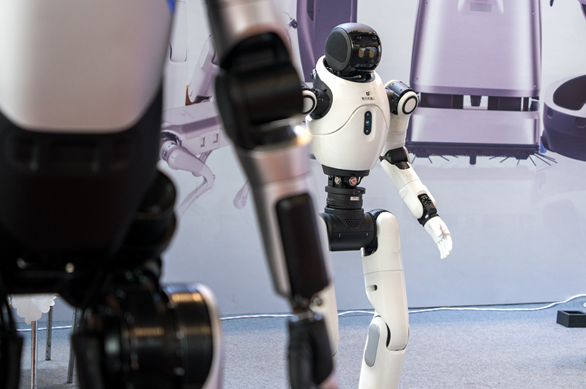
Building on this foundation, the Taibai AR‑series extends force‑control performance to the complete robot unit. It covers a payload range of 3‑20 kg and adopts a seven‑degree‑of‑freedom humanoid configuration with a cross‑axis wrist. Torque sensors are fitted across all joints. The complete machine achieves a force‑control bandwidth above 30 Hz and a force‑control resolution below 0.05 N, alongside an absolute positioning accuracy of ±0.1 mm and a maximum TCP speed of 2 m/s. It combines the high precision and compliant interaction required for industrial operations.
Leveraging the above‑mentioned hardware, Luoshi Robotics demonstrated multiple embodied‑intelligence application solutions covering precision manipulation, mobile operation, data acquisition and other workflows. The demonstrations illustrated how technological advancement has evolved from isolated performance breakthroughs to complex‑task execution. To address challenges in industrial‑chain collaboration, the enterprise opens up its underlying technical capabilities. Instead of pursuing in‑house development of all types of complete robot units, it concentrates on foundational R&D of robot hardware prototypes and motion control, building these capacities into shared industrial infrastructure for the whole sector.
The embodied‑intelligence industrial chain comprises numerous links, and no single market player can deliver all technological innovations independently. Luoshi Robotics continues to open its full set of development capabilities covering hardware R&D, force‑control algorithms and motion control. Going forward, drawing on its end‑to‑end self‑developed technologies, the company will bridge artificial intelligence and the physical world. Through an open industrial ecosystem, it will equip more robot products with reliable hardware prototypes and motion‑control capabilities, accelerating the penetration and real‑world implementation of technologies across diverse industries.
热门内容推荐