Behind Spectacular Feats: Supply‑chain Collaboration Fuels Humanoid Robot Progress
The second World Humanoid Robot Games opens on 22 August at Beijing’s National Speed Skating Oval, known as the Ice Ribbon. Humanoid robots deliver seamless high‑difficulty manoeuvres across competition grounds, displaying levels of agility and stability far beyond earlier iterations. While advances in modelling and algorithm design drive marked performance leaps, a collective push across materials, sensing, chip and battery supply chains forms the underpinning infrastructure that enables robots to stand firm and advance towards real‑world deployment.
As humanoid robots move out of controlled test environments and into open settings with frequent human‑robot interaction, functional safety and reliability are set to become preconditions for high‑quality industrial development.
Every segment of the humanoid robot industrial chain is undergoing systematic upgrading. Encoders sit within rotational joints covering shoulders, elbows and wrists, with a single humanoid robot deploying between 20 and 30 of these devices to feed back positional and velocity data. Robots carrying out running or jumping movements demand encoders capable of handling rotational speeds of tens of thousands of revolutions per minute to sustain transient power surges. Strong anti‑chatter performance is equally vital, keeping joint positioning stable and preventing false alarm triggers under heavy impact at knee and waist joints. Higher precision requirements will emerge as robots take on an expanding range of tasks in coming years.
Inductive‑technology‑based solutions have addressed long‑standing constraints including false alarms under heavy shock, weak anti‑interference performance and limited precision. With balanced overall performance, inductive encoders are emerging as the mainstream technical direction across the sector, and multiple clients are rolling them out in mass production. Dedicated fully‑automated production lines have been put in place for humanoid robot‑related output. Newly‑added capacity reaches four million sets each year; combined with existing facilities, total annual output can hit eight million sets.
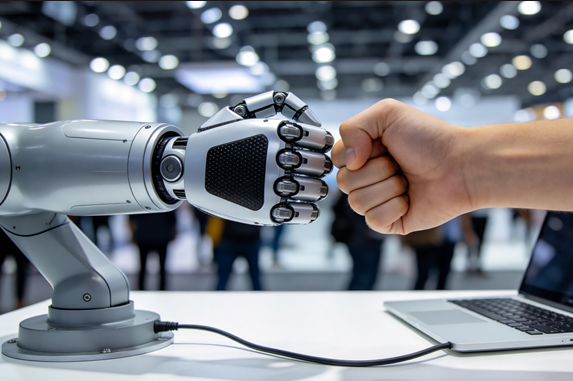
Smooth, stable physical performance also relies on micro‑controller units (MCUs), described as robots’ nervous system. Nearly one hundred MCUs can be fitted onto a full‑size humanoid robot together with dexterous hands. These chips operate as bidirectional information hubs within robot bodies. They receive instructions from main and auxiliary control units, distribute commands precisely to joints and motors to execute target motions, and collect sensor readings across the whole machine for return transmission to main control systems.
Evolving performance requirements redefine technical specifications for robot‑specific MCUs, creating a trade‑off triangle among high performance, low power draw and extreme miniaturisation. Unlike MCUs built for industrial or automotive use, joint compartments inside humanoid robots offer extremely limited physical space. Compact packaging that integrates rich functionality alongside restrained heat generation and power consumption stands as a top priority for many product adopters, calling for multi‑layered optimisation work.
Miniaturisation and low‑energy operation shape wider industry trends. Leading robot manufacturers are exploring gallium‑nitride components for integrated joint main control boards. Gallium‑nitride hardware delivers low‑power, high‑performance characteristics and brings substantial reductions in overall equipment volume. Already deployed at scale within power adaptors and artificial‑intelligence servers, gallium‑nitride solutions are seeing growing adoption in humanoid robot hardware and hold considerable future potential.
Lightweight material development represents another core route for enhancing locomotive capability and energy efficiency. Titanium‑alloy components manufactured via 3D printing are widely fitted onto robot limbs and torso structures, cutting overall weight and improving battery endurance. Custom‑printed titanium‑alloy foot structures deliver wear resistance alongside elastic cushioning, supporting robot operation under diverse working scenarios. In the first edition of the games, many competitors wore human‑designed running shoes to gain shock absorption. Purpose‑built add‑ons now remove the need for repurposed footwear.
Noticeable technical gains notwithstanding, multiple constraints remain as prototype hardware transfers from laboratories and competition arenas into practical industrial and domestic surroundings. Many present‑day robot capabilities reflect isolated breakthroughs. A robot may successfully play table‑tennis while mobile, yet still require human assistance to retrieve a dropped ball. For embodied‑intelligence hardware to shift from delivering experiential value towards productivity‑focused systems, developers must resolve numerous small‑scale, sequential practical challenges that sit outside headline‑grabbing showcase movements.
Battery endurance and heat dissipation persist as long‑standing sector‑wide obstacles. Tuning for electric‑current output within robot bodies has improved noticeably, alongside iterative upgrades for battery cells, bringing substantial real‑world gains in runtime compared with last year. Thermal management remains restrictive, however. Limited internal space rules out sophisticated active cooling hardware; most systems depend purely on natural air convection, forcing end‑product integrators to fit supplementary fan‑based cooling apparatus.
Quality benchmarks for embodied‑intelligence robot supply chains require further refinement. As a comparatively young market segment, embodied‑intelligence hardware records far lower mean time‑between‑failure readings than established industrial robotic arms. Conventional mechanical arms achieve uptimes measured in tens of thousands of operating hours, whereas reaching one thousand hours marks a notable milestone for present‑generation embodied‑intelligence devices.
Sharply rising industry shipment volumes compress component delivery timelines and place pressure on hardware suppliers. Original‑equipment manufacturers issue triple requirements for six‑axis force‑torque sensors: high reliability, compact dimensions and low unit cost. Lead times that conventionally stretch across six weeks are pushed down to two weeks. Component suppliers call for greater allowance for development cycles from downstream partners, given that end‑user safety and dependability carry paramount importance for mass public‑facing deployment.
Functional safety and cybersecurity evolve from desirable extra features into essential preconditions for sustainable industrial expansion as robots step out of enclosed testing zones into unconfined human‑machine interaction environments. Functional‑safety mechanisms uphold baseline standards for human‑robot coexistence: hardware must maintain predictable behaviour during unexpected malfunctions, for instance by halting movement instead of lurching forwards. Hardware‑rooted encryption and secure boot protocols meanwhile mitigate risks of remote malicious hijacking.
Extended sequential operational tasks amplify safety demands. Any minor fault within a single module can trigger full‑mission failure when multiple movements run in sequence, pushing reliability requirements for every hardware link to stringent levels.
Leading industrial‑chain participants are already rolling out relevant arrangements. More than 95 per cent of robot‑oriented MCU products support functional‑safety specifications, with major robot clients paying increasing attention to both functional and cybersecurity criteria.
Collective efforts from participants across industrial chains will underpin robust growth for this emerging sector, driven by innovation, measured development cycles and rigorous engineering standards, as embodied‑intelligence robots progress from dazzling competition‑ground displays towards steady service within factories and households.
热门内容推荐