Anhui fosters advanced‑future‑industry clusters across the Yangtze‑Huaihe basin
A multi‑layered modern industrial framework and dedicated initiatives for emerging‑future industries are taking solid shape across Anhui Province, opening fresh chapters for high‑tech manufacturing along the Yangtze‑Huaihe river plains.
At a deep‑space‑exploration laboratory within Hefei’s Zhong’an Chuanggu science park, a silver‑coloured hardware unit carries out lunar‑regolith water‑ice extraction. Two spiral drill bits penetrate ice‑bearing lunar soil, heating material to generate water vapour which condenses into collectable water‑ice. The system yields between ten and fifty grams per hour. Its development resolves critical technical barriers for lunar‑water‑resource utilisation and lays practical groundwork for deep‑space resource exploitation.
Exhibition halls operated by China Telecom Quantum Group in Hefei High‑Tech Zone showcase two quantum‑integrated consumer‑oriented products. Mobile handsets fitted with quantum‑enabled SIM cards generate unique quantum encryption keys for every call, strengthening communication security. A quantum cloud‑seal device logs every stamp‑impression event in real‑time, recording location and content for full backend traceability. Hefei stands as a major origin hub for quantum‑technology innovation and hosts the group’s headquarters. Industrialisation for quantum‑communication and quantum‑computing technologies keeps gathering momentum. Thirteen quantum‑focused enterprises operate within the Zhong’an Chuanggu science‑park compound, while Quantum Avenue nearby brings together more than thirty leading quantum‑technology firms covering quantum‑computing, communication and metrology. A complete industrial ecosystem now links fundamental research through to commercial roll‑out.
At a busy road junction in Wuhu, intelligent‑police robots developed by Mojo Robotics execute standard traffic‑control gestures alongside human‑operated policing teams. Over 110 units have been deployed across more than thirty domestic cities in the first half of the current year. Drawing on manufacturing competence, sophisticated supply‑chain networks and global distribution channels built up by Chery Group, Mojo Robotics has delivered more than 2 000 robot units worldwide, placing hardware in over sixty nations and territories across scenarios including automotive retail, smart urban policing and medical guidance.
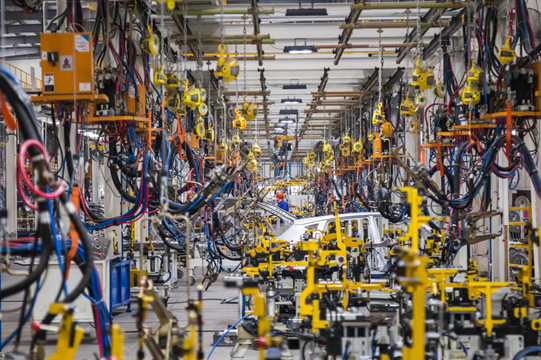
Wuhu became China’s first national‑level pilot zone for robot‑industry agglomeration back in 2013. Spun‑off from Chery’s automotive industrial chain, local flagship robot manufacturers have emerged. A full‑value‑chain ecosystem spans component production, complete‑machine assembly, system integration and real‑world deployment, gathering upwards of 300 upstream‑and‑downstream firms and reaching an industrial scale of 40 billion yuan. Robotic‑sector expansion rests firmly on high‑performance computing infrastructure. Local computing resources support robot‑model training, artificial‑intelligence algorithm iteration and massive‑dataset processing, accelerating commercial scaling for embodied‑intelligence applications. As a key node within the Yangtze River Delta’s East‑to‑West computing‑resource allocation project, Wuhu has built 224 700 standard server racks by July of the current year, delivering 64 000 petaflops of intelligent‑computing capacity, equivalent to simultaneous operation of roughly 32 million high‑performance personal computers.
In western Anhui’s Lu’an city, institutional innovation drives progress across the full hydrogen‑energy industrial chain. Within a local hydrogen‑industrial park, hydrogen produced via photovoltaic electrolysis flows directly through pipelines to an adjacent hydrogen‑refuelling station, substantially cutting expensive intermediate‑storage‑and‑transport workflows. Revised local regulatory provisions permit hydrogen‑production‑and‑refuelling integrated stations outside chemical‑industrial zones when safety criteria are satisfied. Previous rules confined such facilities exclusively to chemical‑park precincts, keeping hydrogen‑generation capacity geographically distant from major urban end‑users. The regulatory adjustment curbs hydrogen‑logistics costs and unlocks expanded operational space for hydrogen‑related enterprises.
General‑purpose artificial intelligence, low‑altitude‑economy applications, brain‑computer interfaces, stem‑cell research and chip development receive tailored deployment across Hefei, Wuhu, Bengbu, Huainan and Chizhou. Co‑ordinated tiered development unfolds across geographically‑dispersed sites. The aggregate industrial output from Anhui’s first batch of ten provincial‑level future‑industry pilot zones exceeds 93 billion yuan. Supply‑chain linkages grow stronger and innovation resources keep concentrating across general and embodied‑AI, brain‑computer interfaces, bio‑manufacturing, 6G communications and hydrogen‑energy sectors, enabling future‑industry projects to materialise and form concentrated industrial clusters.
Regional industrial stakeholders keep refining hardware outputs, regulatory frameworks and supply‑chain arrangements. New‑generation high‑tech products originating from Anhui will enter wider domestic and international markets as industrial roll‑out proceeds.
热门内容推荐