Green‑focused mining transformation unlocks greater value from mineral resources across China
According to China Daily, China is advancing sweeping green reforms across its whole mining lifecycle, spanning mineral exploration, resource extraction and post‑mining ecological restoration. More than 5,600 green mines at provincial and national levels are now in operation, as technological upgrades draw higher yields from existing ore bodies while limiting harm to surrounding natural environments.
At the Shizhuyuan polymetallic deposit in Chenzhou, Hunan Province, complex intergrowth of 143 different minerals once created formidable technical barriers to efficient recovery. Continuous technical research has unlocked economic value from low‑grade ores that previously lay unexploited. The tungsten ore dressing recovery rate has risen from 26.8 per cent to above 70 per cent, whilst fluorspar recovery has climbed from less than 30 per cent to over 65 per cent. In total, 150 million tonnes of ore resources have been brought into effective utilisation.
Technical innovation underpins low‑disturbance green exploration work. Work practices refined within the Qihe‑Yucheng iron‑ore zone in Shandong Province protect farmland throughout drilling operations. Topsoil layers thicker than 30 centimetres are stripped and stored before rigs move on‑site. Mud is circulated inside dedicated facilities rather than held in excavated mud ponds. Once fieldwork concludes, the preserved topsoil is replaced layer‑by‑layer before deep ploughing and fertilising commence. Soil sampling runs before and after construction generate comparative data for environmental verification. Under the 14th Five‑Year Plan, this exploration zone has added 142 million tonnes of high‑grade iron‑ore resources. Temporary land occupation for individual drilling projects has fallen by more than 10 per cent, and overall construction durations have shortened by over 20 per cent, with 100 per cent successful restoration of temporary farmland.
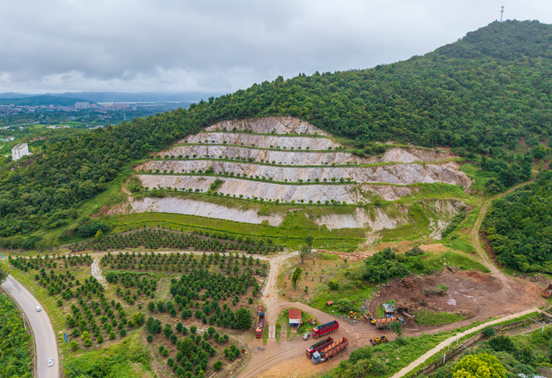
Forested regions also benefit from revised field techniques. Low‑angle drilling developed in Heilongjiang replaces traditional open trenching for geological sampling. Adjustable rig bases allow multiple boreholes from a single working platform, cutting equipment relocation work and fresh land clearance. Since 2019, over 50,000 metres of low‑angle drilling has been completed across more than 50 projects in Heilongjiang. These operations have safeguarded more than 600,000 square metres of woodland and saved woodland compensation costs exceeding 50 million yuan. Better‑quality deep rock cores also deliver clearer geological information for prospecting teams.
Regulatory and technical frameworks keep pace with practical field progress. In 2025, the Ministry of Natural Resources released the first catalogue for prospecting equipment upgrades covering 135 separate items across six categories. Further supporting documents have since been rolled out. National standard project approval for solid‑mineral green exploration specifications took place in April this year. Budget standards for green mineral exploration were issued in July, followed by formal publication of the Solid Mineral Green Exploration Specification in September. Equipment upgrades, formal standards and funding safeguards move forward in tandem to embed minimal‑disturbance requirements at every stage of prospecting work.
Mining operators continue to lift three core efficiency indicators: overall mining recovery, ore‑dressing recovery and comprehensive resource utilisation rates. Upgraded mining methodologies and machinery at the Shizhuyuan site have lifted in‑situ mining recovery above 95 per cent, with annual mining capacity reaching 3.5 million tonnes. Close collaboration with research institutes has expanded the range of recoverable useful minerals to 11 distinct types. Annual fluorspar concentrate output now hits 350,000 tonnes. Waste rock and tailings generated during processing find new applications underground. At a mining operation in Song County, Henan, tailings and excavated rock serve as backfill within underground worked‑out zones. This reduces stockpiling on the surface and boosts underground rock stability.
Digital control systems also raise operational performance. The intelligent control centre at Huibaoling Iron Mine in Linyi, Shandong integrates 15 separate subsystems for centralised monitoring of ventilation, compressed‑air and hoisting plant. On‑site supervisors gain real‑time operational visibility to respond rapidly when faults emerge. Trial blasting work has cut the proportion of oversized rock fragments after detonation from 25 per cent down to 7 per cent. Combined with automated ore‑dressing modifications, unit production costs for iron concentrate have dropped by 5.88 yuan per tonne. Across the sector, re‑evaluation of low‑grade and associated mineral deposits revives deposits previously written‑off as unworkable. Unmanned underground mining operations are becoming increasingly commonplace, shifting evaluation priorities away from raw output volumes towards resource‑use efficiency.
Large‑scale ecological restoration programmes reshape former mining landscapes. During the 14th Five‑Year Plan period, restoration work has rehabilitated 3.35 million mu of land affected by historical abandoned mines. This figure exceeds the original planning target by 19.6 per cent. Central fiscal funding has backed 68 demonstration restoration projects, mobilising local governance investment. De‑commissioned mining zones transform into public parks. The Desheng Mine Park in Xingtai, Hebei, offers local residents recreational open space, while surrounding communities develop new income streams from ecological tourism and specialist forestry. At Kunyang Phosphate Mine in Yunnan, operators have invested more than 500 million yuan into continuous environmental treatment. Land reclamation reaches 77.53 per cent and vegetation restoration hits 95.32 per cent, laying foundations for local flower and vegetable cultivation industries.
Administrative oversight for green‑mine listings remains dynamic. Sites failing to satisfy formal standards will be removed from official registers. New mining developments are required to comply with green specifications from the outset, and existing producing mines carry forward accelerated green retrofitting. Former environmental burdens are progressively converted into ecological and economic assets. By raising the “green component” within its whole mining industry, China charts a steadily expanding pathway for high‑quality mineral‑sector development.
热门内容推荐