Jianghan‑Shennong TBM starts tunnelling on Yangtze‑to‑Han River Diversion Project
According to China South‑to‑North Water Diversion Group, the Jianghan‑Shennong hard‑rock tunnel‑boring machine began its tunnelling operation on 28 September inside the upper assembly cavern of the project’s No 3 horizontal adit. It marks the ninth TBM to be launched for the Yangtze‑to‑Han River Diversion scheme.
By the date of launch, the main tunnel of the project had achieved a cumulative tunnelling length of more than 38 kilometres. Out of the planned cluster of ten TBMs for the whole construction site, nine had commenced excavation work.
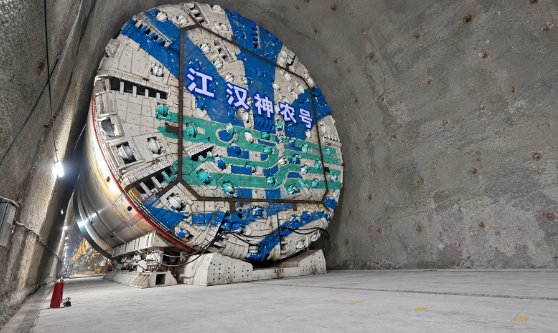
Jianghan‑Shennong is a domestically‑built large‑diameter double‑shield hard‑rock TBM. Its excavation diameter measures 11.93 metres, with an overall machine length of roughly 175 metres and a total weight of around 3 550 tonnes. Assembled inside the tunnel, the machine will drive forward to complete a 11.68‑kilometre‑long water conveyance tunnel section.
The machine is equipped with specialised facilities to cope with difficult underground conditions including rock bursts, high in‑situ stress, high‑strength rock, heavy external water pressure and fault fracture zones. Monitoring systems for micro‑seismic rock‑burst detection, real‑time disc‑cutter inspection and advance drilling have been fitted to deliver early warnings of geological hazards. Drawing on practical construction records gathered from the previous eight TBM units, engineers carried out targeted upgrades for multiple functional parts. A damping‑particle vibration‑reduction technology has also been applied. The improvement sustains continuous tunnelling under harsh geological circumstances, extends service life of mechanical components and cuts operational maintenance expenditure.
The Yangtze‑to‑Han River Diversion represents the first major project initiated under the follow‑up works of the South‑to‑North Water Diversion programme. Its total route stretches approximately 194.7 kilometres, with an average annual water transfer volume of 3.9 billion cubic metres. Once finished, the infrastructure will raise the water‑supply capacity and reliability of the existing first‑phase middle route, strengthen water‑resource regulation across the Han River basin, and lay conditions for the long‑term water‑transfer targets of the Han‑to‑Wei River Diversion Project.
热门内容推荐