Second reactor starts construction at Guangxi Bailong nuclear‑power site
According to State Power Investment Corporation, the first concrete pour (FCD) for the nuclear island of Unit 2 at Guangxi Bailong Nuclear Power Project took place at 18:27 on 27 September. The milestone moves the first‑phase works into a new phase of full‑scale construction for two reactor units.
The FCD operation for Unit 2 adopts a one‑off continuous monolithic pouring method with unilateral advancement. Approximately 6 637 cubic metres of concrete are scheduled to be placed across around 58 consecutive working hours.
Faced with technical challenges including a large‑sized irregular base slab and exacting requirements for temperature control and curing, the construction team drew up dedicated construction plans in advance.
Engineers optimised pouring routes and technical parameters. Low‑heat cement, pre‑cooled raw materials and tight limits on concrete temperature at the point of placement were deployed for primary temperature management.
An intelligent temperature‑measuring system monitored temperature differentials in real‑time, paired with combined curing techniques of membrane‑based moisture retention and dynamic thermal regulation to improve the concrete’s crack‑resistance.
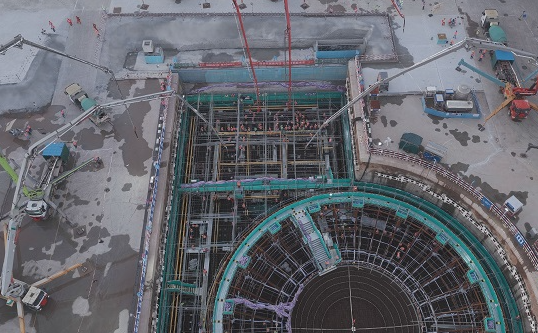
A smart engineering platform coordinated site resources, with shift‑based working arrangements to sustain uninterrupted concrete pouring.
Situated on the southern tip of Jiangshan Peninsula in Fangchenggang, the Bailong complex has a master‑plan for two CAP1000 reactors together with four Guohe‑One (CAP1400) units. Total installed capacity stands at roughly 8.5 gigawatts, with overall investment estimated at 120 billion yuan.
Units 1 and 2 of the first‑phase scheme deploy the third‑generation passive CAP1000 nuclear technology, each with an individual generating capacity of 1 250 megawatts.
Once the first‑phase installation becomes operational, annual power output will reach approximately 20 billion kWh. The facility will cut annual consumption of standard coal by around 6 million tonnes.
Annual reductions cover roughly 16 million tonnes of carbon dioxide, 52 000 tonnes of sulphur dioxide and 45 000 tonnes of nitrogen oxides. The carbon‑removal benefit matches the carbon‑sequestration capacity of around 44 000 hectares of broad‑leaved forest.
热门内容推荐