World’s First Ship-to-Ship Bunkering of Green Ammonia Fuel Completed
According to China Energy Engineering Corporation Limited, published 15 October 2026, the world’s first ship-to-ship bunkering of green ammonia fuel was finished on 13 October at an offshore anchorage of Zhoushan Port in Zhejiang Province. A total of 1,000 tonnes of green ammonia from the group’s “Qingqing No.1” Songyuan Hydrogen Energy Project was delivered in the operation.
The green ammonia deployed for bunkering comes from the “Qingqing No.1” China Energy Songyuan Hydrogen Industrial Park project, the world’s largest integrated green hydrogen, ammonia and methanol facility.
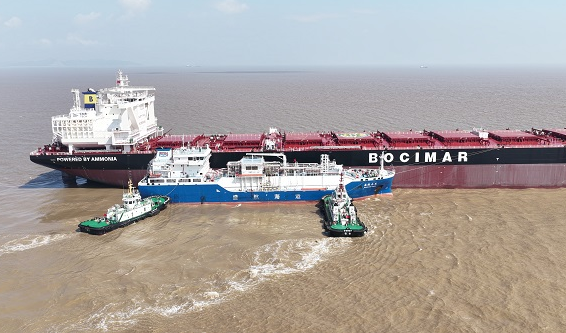
The fuel departed from Songyuan and was moved by low-temperature liquid ammonia tank lorries to tank zones at Nanjing Port. It was then shipped to Zhoushan Port aboard Shenghang Yongle, the world’s first dedicated liquid ammonia bunkering vessel. The cargo was supplied to a 210,000-tonne ammonia-powered vessel belonging to Belgian shipping group CMB.TECH.
The operation links the complete workflow of green ammonia production, overland transport, port storage, seaborne carriage and offshore ship-to-ship bunkering, with carbon emissions meeting standards throughout the full supply chain. After bunkering, the ammonia-powered vessel will leave Zhoushan, cross the Pacific Ocean and travel to Australia for commercial shipping.
Green ammonia can be manufactured at scale using wind, solar and hydropower resources. Its combustion produces no carbon dioxide, achieving near-zero carbon emissions over its entire lifecycle. The fuel also features high volumetric energy density, easy liquefaction and storage, and compatibility with existing hazardous goods storage and transport infrastructure.
It ranks among the commercially promising zero-carbon fuels for deep decarbonisation of deep-sea shipping. Ammonia carries safety hazards, which demand strict safety controls in storage, transportation and offshore bunkering. Safe ship-to-ship ammonia bunkering represents a critical checkpoint for the commercial rollout of green ammonia as marine fuel.
The bunkering work was conducted via ship-to-ship transfer at the offshore anchorage instead of alongside port berths. In this anchorage bunkering arrangement, a specialised bunkering vessel moors next to the receiving ship and conveys fuel through low-temperature, corrosion-resistant specialist hoses.
The procedure does not occupy port berths or require dedicated onshore terminals, allowing refuelling during cargo discharge, berth waiting or voyage rerouting. This method reduces transit and logistics time by 8 to 12 hours relative to in-port bunkering and shows distinct efficiency benefits along major shipping routes.
The completed bunkering operation delivers full verification of the domestic green ammonia storage, transport and bunkering system under rigorous safety criteria.
热门内容推荐