First unit of CGN’s Tuanfeng Weijiachong pumped storage station enters commercial operation
According to China General Nuclear Power Group, the first generating unit of the Tuanfeng Weijiachong pumped storage power station came into commercial operation on 16 October. It marks the first medium‑to‑small pumped storage project commissioned during China’s 15th Five‑Year Plan period.
The station sits in Weijiachong Village, Dupi Township, Tuanfeng County, Huanggang City, Hubei Province. Its total installed capacity stands at 298 megawatts, supported by two reversible pump‑turbine generator sets each rated at 149 megawatts. The scheme comprises an upper reservoir, a lower reservoir and water conveyance and power generation systems. The unit brought online is Unit 1, while Unit 2 is undergoing commissioning and is scheduled for launch within the calendar year.
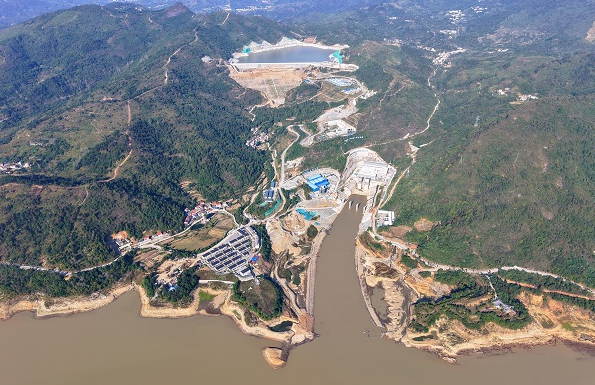
The site lies on the southern flank of the Dabie Mountains, where heavily jointed rock within large‑section shafts creates difficult ground conditions. The project adopts an oval semi‑underground powerhouse layout. Curved structural elements boost the stability of the main building while offering flexible space for equipment arrangement. Construction teams deployed a twin pilot shaft and zoned layered blasting technique for underground works, overcoming technical barriers linked to excavation and support for ultra‑deep shafts. The station now hosts China’s deepest semi‑underground powerhouse shaft, at 73.4 metres.
CGN worked with domestic supply‑chain partners to develop bespoke pump‑turbine runners, addressing stability risks when medium‑to‑small pumped storage sets connect to the grid. Refined hydraulic design supports safe, stable and efficient operation of the units. The scheme also uses the existing Henghe Reservoir as its lower pond. This arrangement cuts land acquisition requirements and reduces disturbance to local ecosystems.
The facility forms a priority project under the national Medium‑ and Long‑Term Development Plan for Pumped Storage. Its designed annual pumping consumption is 440 million kilowatt‑hours, and its annual power output is 330 million kilowatt‑hours. The scheme delivers an equivalent coal saving of 113,000 tonnes each year and cuts carbon dioxide emissions by 282,000 tonnes. Once fully operational, the station will deliver peak shaving, valley filling, frequency regulation, phase modulation, energy storage and emergency back‑up services for the Hubei power grid. It will strengthen grid stability and raise local absorption capacity for wind and solar generation.
热门内容推荐