Shandong Energy builds smart green power hub for gigawatt-scale wind, solar and storage control
According to the Shandong Provincial State-owned Assets Supervision and Administration Commission, Shandong Energy New Energy Group has completed a regional core complex in Dongying. The facility brings together a data centre, central control centre, smart operation centre, regional management centre, research and development centre and talent training base under one site. It is the first installation of its kind in China and delivers centralised management and one-stop operation and maintenance for new energy projects with a combined capacity of ten million kilowatts.
The smart operation centre hosts a closed-loop whole-chain management system. Live operational readings from onshore and offshore wind turbines and energy storage stations feed into large display screens, showing equipment status, environmental parameters and alarm signals from remote sites. The framework covers safety oversight, full-lifecycle equipment management and power market trading. It introduces an industry-first vertical management mechanism across four professional streams: safety, equipment, trading and operation, forming a connected workflow from risk warning and equipment diagnostics to power trading and dispatch.
Widespread intelligent sensing terminals form a graded early-warning network with linked response protocols to identify hazards at an early stage. Digital twin technology generates three-dimensional replicas of all site equipment, enabling round-the-clock monitoring and shifting equipment management from reactive repairs to predictive fault identification. The platform links directly with the provincial power trading system to match green power supply with market demand and raise local consumption and commercial utilisation rates.
The group has created a five-dimensional intelligent operation system spanning space, sky, land, sea and subsea to overcome geographic barriers for scattered wind and solar sites, where offshore maintenance is constrained by weather and sea conditions and power output fluctuates intermittently. Satellite and Beidou remote sensing systems gather meteorological data across land and sea zones. Unmanned inspection drones follow pre-set flight paths to spot blade damage and photovoltaic hotspots, outperforming manual inspection speeds. Ground robots carry out regular checks on onshore facilities and take over high-risk, repetitive inspection tasks. Subsea survey gear detects corrosion and marine growth on subsea pipelines and foundation piles, filling gaps in underwater maintenance capability.
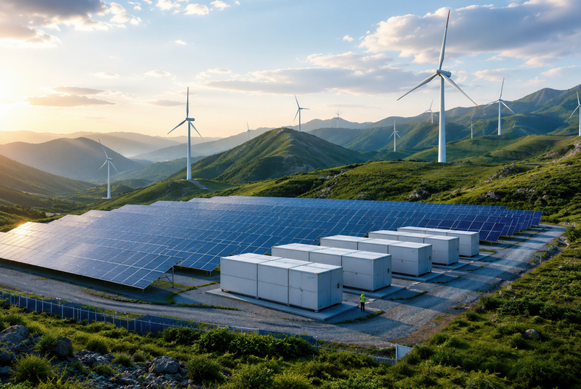
Multi-source datasets from meteorological satellites, wind and radiation measurement stations and historical generation records feed into self-developed algorithm models for high-precision wind and solar power forecasting across multiple time horizons, reaching advanced industry standards. The centre co-ordinates operations with shared energy storage assets. Storage units absorb surplus power during high-output periods and release electricity at times of low generation to smooth volatility and improve grid absorption capacity.
A standardised training hub operates alongside the technical platform. It is fitted with full-scenario digital training hardware and site simulation systems, delivering structured courses covering onshore and offshore wind power, photovoltaic generation, energy storage and central dispatch. The integrated training model combines theoretical tuition, virtual simulation and practical site work, supporting the development of multi-skilled engineers with expertise in equipment maintenance, power dispatch and digital technology application.
Shandong Energy New Energy Group will continue to roll out digital and artificial intelligence applications to optimise energy structures and sharpen digital operational capacity as a core strength for green transition. The platform will deliver steady, clean and efficient green power supplies.
热门内容推荐