Science-led Forage Sector in Hinggan League Generates £1bn Industrial Output from £120m Funding
According to Farmer Daily Client, 29 October 2026, the modern forage processing, logistics and trading park of Alideer in Horqin Right Front Banner, Hinggan League, Inner Mongolia, hosts more than 80 enterprises and records an industrial chain output value of 1 billion yuan. The site is the largest and best-equipped forage industrial park across Inner Mongolia.
Hinggan League lies on the transitional zone from the middle Greater Khingan Range to the Songnen Plain, with 26.8388 million mu of grassland and 1,050 recorded wild plant species. Continuous heavy grazing and a livestock stock maintained above 10 million head for seven years created a substantial shortage of high-quality forage, including an alfalfa deficit of 64,000 tonnes in 2022. The Hinggan League Science and Technology Bureau introduced technological innovation to scale up intensive forage production and ease supply pressure.
Limited forage germplasm restricted local development. Most local growers relied on a narrow range of varieties and had no domestic high-grade alfalfa seed supply, requiring outside or imported forage. Authorities supported research bodies to build wild plant nurseries and leymus chinensis germplasm gardens, conserving nearly one hundred wild plant accessions. Eight strains of leymus chinensis, four alfalfa lines and two native herb varieties were selected to ease seed supply constraints.
Inner Mongolia Yuanmu Forage Industry Company has expanded its leymus chinensis planting area to 184,000 mu, using improved varieties developed by the Institute of Botany of the Chinese Academy of Sciences and the Grassland Research Institute of the Chinese Academy of Agricultural Sciences. Seed multiplication plots for leymus chinensis and nettle varieties run by research institutions cover 9,800 mu within Hinggan League.
A joint project entitled “Creation of new forage germplasm and breeding and promotion of new varieties” received 5 million yuan in funding. The partnership brought together the Hinggan League Academy of Agriculture and Animal Husbandry, Baicheng Academy of Agriculture and Animal Husbandry and Beijing Forestry University to breed cold-resistant, drought-tolerant and high-yield alfalfa, oat and leymus chinensis varieties with independent intellectual property rights.
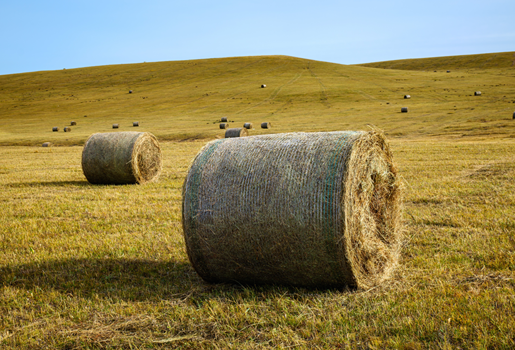
The industrial park manufactures grass meal, grass pellets, extruded feed and fermented feed. Local forage enterprises have an annual production capacity of 50,000 tonnes of finished forage products. Straw is also processed into 40,000 tonnes of cured grass bales, 3,000 tonnes of extruded fermented feed and 7,000 tonnes of square and round bales each year. Finished forage goods are transported to Hebei, Shandong and Zhejiang under stable distribution arrangements.
Animal husbandry authorities operate an intelligent grass-livestock balance monitoring system based on internet of things, big data and artificial intelligence to supervise grassland vegetation. Core demonstration fields for alfalfa varieties and high-yield cultivation techniques for leymus chinensis have been established in Horqin Right Front Banner and Horqin Right Middle Banner, covering a total of 50,000 mu of extended planting land.
The Northern Agricultural and Pastoral Technology Innovation Centre of the Chinese Academy of Agricultural Sciences is investing 2 million yuan in partnership with Inner Mongolia Yuanmu Forage Industry Company to build a forage central kitchen. The facility will carry out research on natural grassland fertility management, stress-resistant forage breeding, high-efficiency cultivation and high-value functional forage processing.
Eight collaborative platforms have been set up, including an alfalfa biological breeding joint research centre, a digital forage breeding platform, expert workstations and demonstration bases for technology transfer. Since 2022, more than 100 senior specialists have been recruited on flexible terms to support breeding, processing and commercialisation work. Two local forage enterprises have each achieved annual operating revenue exceeding 20 million yuan.
A total of 12 million yuan of special science funding has backed more than 20 forage research projects from 2022 onwards. One hundred and twenty-three enterprises and cooperatives now operate across planting, seed multiplication, processing and sales.
The sector still faces constraints including insufficient germplasm resources, outdated cultivation techniques, short industrial chains and limited research investment. Planned work includes expansion of wild plant nurseries, purification and rejuvenation of leymus chinensis and alfalfa varieties, and the roll-out of standardised cultivation systems. A specialist expert team will oversee thousand-mu demonstration sites. Deep-processing research will develop forage extracts and functional feed products. Further industry-university partnerships will build joint laboratories and pilot lines, while a dedicated science fund will nurture local technical staff.
热门内容推荐