Green Power Industry Forms Full Supply Chain in Guazhou’s Gobi Desert over Five Years
According to the State-owned Assets Supervision and Administration Commission of Gansu Province, published on 2 November 2026, Guazhou County in Gansu has built a complete renewable energy industrial chain across five years, drawing on its abundant wind and solar resources.
The county has added 11,505 megawatts of energy capacity in the five-year period, equivalent to 1.2 times its cumulative installed capacity before this phase. Annual grid-connected electricity output has exceeded 40 billion kilowatt-hours. Total installed power capacity now stands at 20,805 megawatts. Wind capacity reaches 12,140 megawatts, the highest figure among all county-level regions in China for successive years. Photovoltaic capacity is 1,720 megawatts, concentrated solar thermal capacity 100 megawatts and peak-regulating thermal power capacity 6,000 megawatts. Clean energy accounts for 71 per cent of total installed capacity, forming a stable energy framework anchored by wind and solar generation, supported by thermal power for load regulation and energy storage facilities.
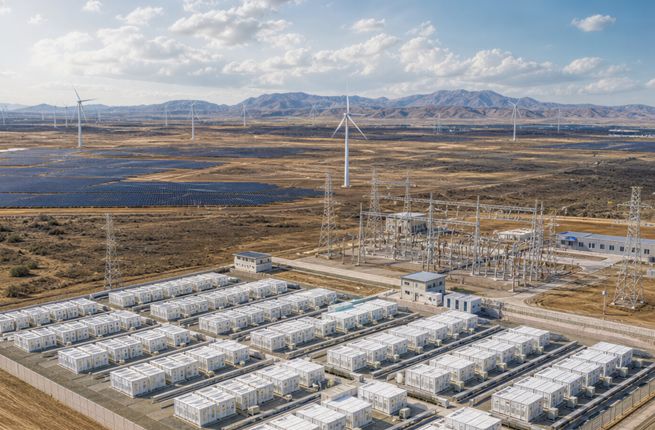
The county’s energy authority stated that the five-year period represents the fastest phase of expansion for Guazhou’s new energy sector, with operations shifting from simple resource exploitation to large‑scale, intensive and chain‑based development.
Gansu Power Investment’s Changle Power Plant entered full commercial operation on 16 October 2025 with six 1,000-megawatt coal-fired units. It is the largest million-kilowatt peak-shaving thermal power plant in the country. As a core flexible resource for the Qi-Shao ultra-high voltage transmission line, the plant can generate 33 billion kilowatt-hours each year. It supports 60 billion kilowatt-hours of annual output from new energy bases in the Hexi region and facilitates 40 billion kilowatt-hours of cross-provincial green power delivery. Thermal generation offsets the intermittent nature of wind and solar output to stabilise grid supply.
Demonstration projects are running alongside the thermal peaking scheme. The Three Gorges Hengji Energy “two towers, one receiver” concentrated solar thermal storage station adopts a dual central tower and overlapping heliostat field layout. Jiuquan Taiyuan New Energy has commissioned Gansu’s first 50MVar distributed synchronous condenser on the generation side, improving grid stability for renewable integration.
Energy storage and green hydrogen sectors have expanded rapidly. A manufacturing facility operated by Huantai Industrial Guazhou houses vanadium redox flow battery storage systems, which smooth volatile wind power output. The facility’s quality management team noted that the technology carries environmental and safety advantages, supports frequent charge and discharge cycles and retains high residual value, making it suited to large-scale long-duration storage.
Guazhou has commissioned 17 energy storage stations with combined capacity of 836 megawatts, while five further storage projects are under construction. The county is developing flywheel‑lithium hybrid storage and hydrogen‑lithium hybrid storage pilot schemes.
Work is advancing on the Hexi Green Hydrogen Corridor. The Runlong Hongneng wind‑solar hydrogen coupled 250,000-tonne green methanol project has started construction. China General Nuclear Power Group is carrying out preparatory work for an off-grid hydrogen project linked to 50,000 tonnes of synthetic ammonia. Refuelling infrastructure is also being planned.
A modern new energy industrial hub with diversified sources and coordinated operations has taken shape across the Gobi terrain. Guazhou will continue to develop its renewable energy portfolio and expand integrated “new energy plus” models.
热门内容推荐