Main Arch Rib of Xiaohuanggou Estuary Bridge on National Highway G331 Joined
According to China Railway Group Limited, published on 20 November 2026, the main arch rib of Xiaohuanggou Estuary Bridge, the largest-span concrete-filled steel tube arch bridge in north-east China, was closed on 16 November. The structure forms part of the Lagushao to Hunjiangkou section of National Highway G331, with China Railway Industry under China Railway Group Limited participating in construction.
National Highway G331 runs from Dandong in Liaoning to Altay in Xinjiang, an important border corridor linking north-east and north-west China, with an overall length of approximately 9,333 kilometres. The Lagushao to Hunjiangkou stretch lies within Kuandian Manchu Autonomous County, Dandong, Liaoning. It starts at Lagushao in Dandong and terminates at Hunjiangkou, the boundary between Xialuhe Korean Township of Kuandian and Ji’an City in Jilin Province. It constitutes a key new segment of the national border and coastal outer ring corridor outlined in the 15th Five-Year Plan, and the core link connecting the Liaoning section with Jilin’s border road network.
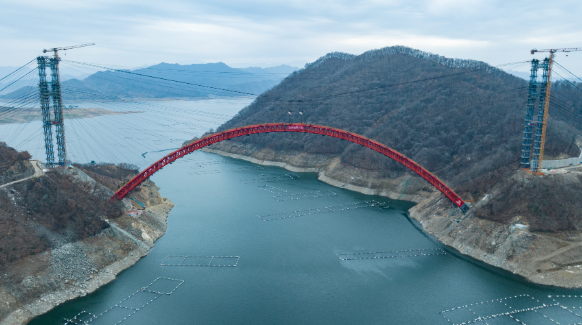
Xiaohuanggou Estuary Bridge sits in Kuandian Manchu Autonomous County, Dandong. It measures 442.25 metres in total length and 8.5 metres in width, with a main span of 352 metres. As a large-span concrete-filled steel tube arch bridge, it serves as a critical control structure for the whole route. The site is situated in a border mountainous area, where strong valley winds and narrow terrain create substantial challenges in arch rib geometry and structural load control.
Digital technologies support construction throughout the workflow. Closed-loop data management covers factory pipe fabrication, ground assembly, segment transportation and matching to guarantee assembly precision. CATIA software is adopted for three-dimensional modelling, detailed layout and spatial posture simulation of the arch rib, while Midas software carries out structural calculation, working-condition simulation and pre-camber adjustment. The modelling assesses deformation caused by temperature variation, wind load and dead weight, refining pre-camber settings and enabling zero-error closure.
Once the Lagushao to Hunjiangkou section is completed, it will complete the border transport loop around Dandong, connect cultural and tourist resources along the Yalu River, remove the long-standing reliance on ferry crossings and winding mountain roads for villages nearby, and support the growth of local border industries and tourism.
热门内容推荐