Yellow River Ends 2025–26 Ice Flood Season Smoothly, Monitoring and Dispatching Ensure Safety
Beijing, 14 March 2026 – The Yellow River’s frozen river sections have opened along the entire course on 14 March, marking the smooth conclusion of the 2025–26 ice flood season without any major incidents, according to the Ministry of Water Resources.
An ice flood occurs when ice jams obstruct river channels, impeding water flow and causing water levels to rise significantly. Such events commonly occur in northern Chinese rivers during winter ice formation and spring ice breakup. The Yellow River is prone to ice flooding in the Ningxia–Inner Mongolia reach in the upper reaches and the Shandong reach in the lower reaches.
Yao Wenguang, Director of the Department of Flood and Drought Disaster Prevention at the Ministry of Water Resources, outlined the key characteristics of this year’s season.
First, overall above-average temperatures with large fluctuations. Temperatures in the Ningxia–Inner Mongolia reach were 0.3 to 3.8 degrees Celsius higher than normal. During the season, 15 distinct cooling episodes occurred, with an average temperature drop of over 6 degrees Celsius, peaking at 16 degrees Celsius.
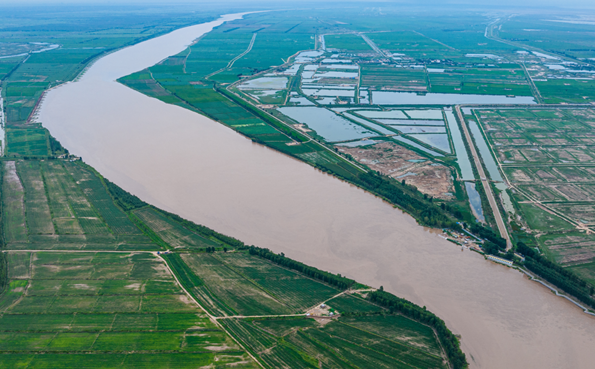
Second, ice formation occurred in the upper and middle reaches with a shorter frozen length. The maximum frozen length reached 716.3 kilometres on 28 January 2026, which is 178 kilometres shorter than the average of the past decade. Notably, no freezing occurred in the lower reaches.
Third, slower ice formation, thinner ice and less reservoir storage in the Ningxia–Inner Mongolia reach. After the initial freezing, it took 39 days for the ice front to reach the Bayangaole section on 11 January 2026, 20 days longer than usual. The average ice thickness across 23 fixed monitoring sections was approximately 45 centimetres, 5 centimetres thinner than the multi-year average. The maximum reservoir storage in the reach from Bayangaole to Toudaoguai stood at 780 million cubic metres, 230 million cubic metres less than normal, creating favourable conditions for a stable ice breakup.
Fourth, an earlier than usual ice breakup. The Ningxia–Inner Mongolia reach opened completely on 14 March, 11 days earlier than the average and 6 days earlier than the decadal average.
To ensure a safe season, water conservancy departments at all levels implemented comprehensive and targeted prevention measures.
Enhanced monitoring and forecasting. Leveraging the integrated "space-air-ground-water engineering" monitoring system, which includes satellite remote sensing from the "Water Conservancy No.1" satellite, unmanned aerial vehicle (UAV) inspections and video surveillance, authorities tracked ice flow density, frozen length, water level and discharge daily. Monitoring frequency was significantly increased during critical ice breakup periods.
Scientific reservoir dispatching. During ice formation, dynamic dispatching plans were optimised based on real-time and forecasted inflow, ice conditions and flow evolution to precisely control the freezing discharge in the Inner Mongolia reach. During ice breakup, the operation sequence, timing, scale and methods of key reservoirs such as Liujiaxia, Haibowan and Wanjiazhai were simulated and adjusted to facilitate the stable release of stored water.
Precision ice diversion. Detailed pre-operation analyses were conducted during the ice breakup. Risk assessments were carried out, and the timing and volume of ice diversion were calculated to dynamically adjust schemes. For instance, on 27 February at 18:00, the ice diversion discharge was reduced from 320 to 210 cubic metres per second, effectively easing downstream ice transport pressure.
Yao Wenguang emphasised that the season achieved the established goals of "safeguarding people’s lives and property and ensuring no dike breaches on the main and tributaries of the Yellow River."
This year’s success demonstrates the effectiveness of China’s scientific and precise ice flood prevention system, safeguarding the river’s ecological security and socio-economic stability.