Chinese Cities Roll Out Refined Measures to Tackle Noise Pollution, Safeguard Residents’ Peace
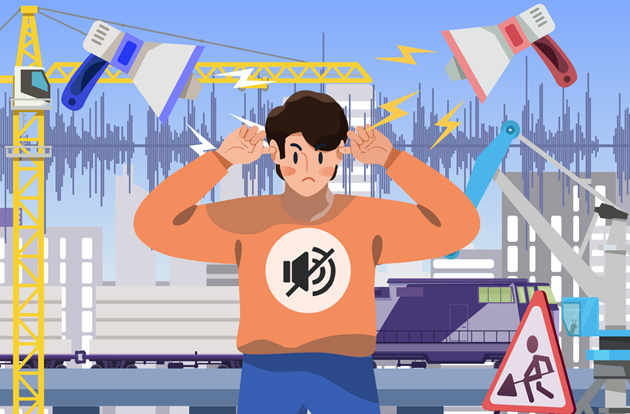
Sharp car horns, rumbling construction work and clattering decoration noises have become a growing concern for the public in recent years, as people’s desire for a livable and quiet environment continues to rise. From improving building quality and grassroots governance to targeting industrial noise disturbances and implementing full-range supervision, cities across China are adopting differentiated and refined noise control measures to comprehensively protect residents’ peace and tranquility.
Tianjin has taken the lead in promoting “quiet communities” by upgrading residential construction standards. At China Construction Yuelu Tongxi Community in Jinnan District, a 27,000-square-meter C-shaped park surrounds the community, adding greenery while blocking noise. “We fully assessed surrounding noise sources during the site selection phase,” said Fan Zhongli, Deputy General Manager of the Innovation and R&D Center at China State Construction Sixth Engineering Bureau (China State Construction Silk Road) Real Estate Company. The community strictly implements pedestrian-vehicle separation and places equipment rooms away from residential buildings, with noise reduction measures such as sunken square sound absorption and green soundscape design.
China State Construction Real Estate has collaborated with Tsinghua University’s Architectural Acoustics Laboratory to build a full-scene quiet residential engineering system. “The floor impact sound insulation performance of our community has reduced more than 90% of impact energy compared with national standards,” said Zhang Zhenpeng, Secretary-General of the High-Quality Residential Innovation Research Institute. Tianjin Municipal Ecology and Environment Bureau requires new quiet communities to meet Class 1 sound environment standards—no more than 55 decibels during the day and 45 decibels at night. By 2024, 209 communities in Tianjin had been rated as “quiet communities.”
Qingdao focuses on reducing industrial noise to avoid disturbing residents. Inside Qingdao Guoen Technology Co., Ltd., once-disturbing low-frequency hums have disappeared, as air compressors are placed in enclosed rooms and fans are equipped with sound insulation chambers. “It’s much quieter at night now, and I can finally sleep soundly,” said Wang Wei, a resident near the company. With help from Qingdao Chengyang Branch of Ecology and Environment Bureau, the company solved “up-to-standard but disturbing” noise issues without slowing down production.
Qingdao has also installed 24-hour automatic noise monitoring equipment. “These ‘sleepless sentinels’ enable real-time monitoring and accurate identification of noise sources,” said Yang Da, an engineer at the bureau. At Chengzi Community station, the daytime noise compliance rate reaches 93.5% and the nighttime rate 99.4%. In early 2025, Qingdao Housing and Urban-Rural Development Bureau issued China’s first government-led guideline on quiet residential design and evaluation, filling a gap in the field.
Zhejiang Province promotes joint governance for noise control. In Funan Garden Community in Jiaxing, a three-party coordination mechanism of community, property and homeowners’ committee has been established, with a resident convention specifying “quiet hours” and banning high-noise activities. “We track every complaint until it is resolved,” said Cao Rongxiang, the community’s property manager. Jiaxing, a national pilot city for quiet communities, has built over 110 such communities. Xinhua News reported that Jiaxing’s average regional environmental noise level is 53.5 decibels, with road traffic noise at 66.8 decibels.
Since March 1 this year, Zhejiang’s Measures for the Prevention and Control of Noise Pollution have been implemented. “We will scientifically delineate sound environment functional areas to reduce noise impact from the planning stage,” said Ye Jun, Deputy Director of Zhejiang Provincial Department of Ecology and Environment. Experts suggest promoting new noise reduction technologies and multi-party co-governance to build a more livable urban environment.
热门内容推荐