Shandong Advances Xiaoqing River River-Sea Intermodal Transport to Boost Logistics Efficiency and Green Development
Water transport, boasting large capacity and low costs, is particularly suitable for long-distance transportation of bulk goods and containers. Shandong Province’s 14th Five-Year Plan Outline proposes building a river-sea intermodal inland waterway network and tapping the potential of the Xiaoqing River waterway as a golden channel for river-sea intermodal transport, laying a blueprint for the province’s water transport development.
Shandong Water Transport Group, affiliated to Shandong Marine Group, takes the Xiaoqing River waterway as the main artery and Jinan Port as the core hub, linking the Bohai Bay port group including Weifang Port. It has made every effort to open up an efficient connection channel between inland rivers and the Bohai Sea, establishing a modern collection and distribution system featuring “direct river-sea transport and multi-modal transport”, which injects strong water transport impetus into regional logistics cost reduction, efficiency improvement and industrial collaborative development.
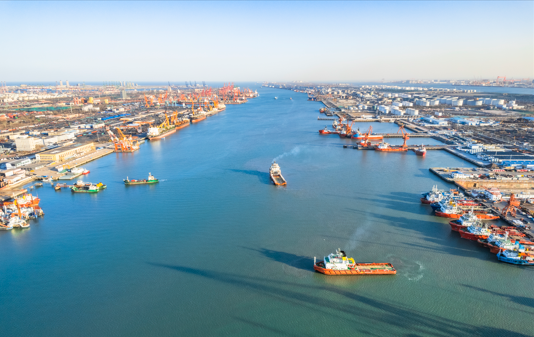
The Xiaoqing River navigation radiates five cities along the route, including Jinan, Zibo and Binzhou, and connects the Beijing-Hangzhou Grand Canal to build the “Jingqing Canal Logistics Corridor”, facilitating the convenient export of inland goods and efficient inland transportation of coastal goods. China Transportation News reported that the Xiaoqing River, as the core “horizontal” line in Shandong’s inland waterway network, stretches 237 kilometers and effectively connects five major industrial cities, opening a golden waterway for inland areas to access the sea.
As a regional leader, Jinan Port has opened Shandong’s first chemical multi-modal transport channel, extending its foreign trade business to Chittagong Port in Bangladesh and Apapa Port in Nigeria. China National Radio noted that this channel, combining road, inland river and marine transport, reduces enterprise logistics costs by 15% to 20% annually compared with traditional land transport.
Other ports along the river have formed differentiated advantages: Zhangqiu Port stands out with its special capacity for over-limit cargo transport; Gaoqing Port focuses on container business expansion, setting up container repair and return points to drive the green transformation of surrounding goods; Boxing Port has strengthened its central position in steel logistics and become the first port along the Xiaoqing River with an annual inbound volume exceeding 1 million tons. These ports have not only boosted the coastal economy but also reduced logistics costs and environmental pollution through green transformation such as “bulk to container” conversion.
Jiang Guodong, Secretary of the Party Committee and Chairman of Shandong Marine Group, stated that the group would adhere to the river-sea intermodal transport development path during the 14th Five-Year Plan period. It will focus on building an eastward outbound core channel, accelerate the construction of a digital port and shipping system, and promote the R&D and construction of green and intelligent ships to build a full inland river industrial chain.
Xinhua News Agency reported that Shandong Marine Group has actively built the Jingqing Canal Logistics Corridor, realizing 13 voyages of cargo transport between the Xiaoqing River and the Beijing-Hangzhou Grand Canal. With continuous optimization of the intermodal transport system, the Xiaoqing River has become a win-win golden waterway for ecology and economy, providing strong support for Shandong’s high-quality development.
热门内容推荐