Fujian Investment Group Builds Diversified Low-carbon Energy System Over the 14th Five-Year Plan Period
Coastal wind turbines harvest steady offshore breeze to deliver renewable power across Fujian’s coastal waters, while coal-fired power plants supply consistent baseload electricity to regional power grids. Large pumped hydro storage facilities nestle within mountainous terrain, acting as giant energy reservoirs to stabilise grid operation and deliver flexible peak regulation capacity. A sprawling network of natural gas pipelines stretches across Fujian, channelling clean energy to industrial zones and residential communities throughout the province. This balanced, multi-source energy landscape marks the tangible progress made by Fujian Investment Group as it constructed a fully-fledged modern energy framework during the 14th Five-Year Plan cycle.
Over the past five years, the group has expanded its asset scale while refining energy mix, fostered low-carbon growth drivers through green transition, and maintained reliable energy supplies for local communities. It has accelerated development across pumped hydro storage, offshore wind power and carbon neutrality-focused industrial segments.
Historic Expansion of Installed Power Capacity
By the close of the 14th Five-Year Plan period, the group’s wholly-controlled power generation capacity surpassed 7.5 gigawatts, with equity-held capacity standing close to 10 gigawatts. Its installed power assets rank first among provincial state-owned enterprises and sit among the largest operators in Fujian’s power generation sector.
The completion of handover procedures for Zhangzhou Houshi Power Plant and Phase I BOT project of Putian Meizhouwan Power Plant in 2025 added nearly 5 gigawatts of controlled coal-fired generating units to the group’s portfolio. These assets underpin secure and stable operation of Fujian’s provincial power grid.
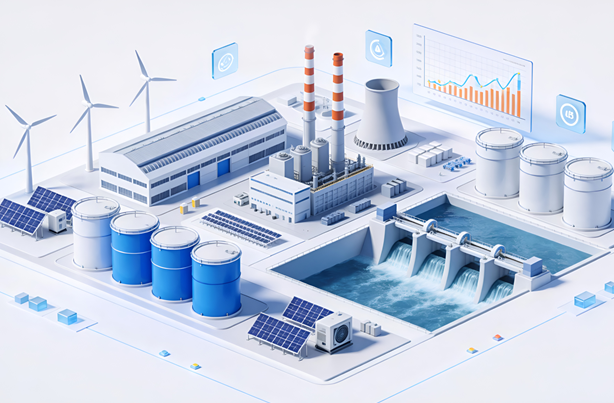
Parallel to consolidating its conventional power portfolio, the group has rolled out large-scale development of clean energy assets. Yongtai Pumped Storage Station, the first facility of its kind independently invested, constructed and operated by provincial state-owned entities, entered full commercial operation. Three further large-scale pumped hydro storage projects in Yong’an, Dehua and Zhangping have broken ground, forming an integrated pumped storage cluster with a combined capacity of 4.8 gigawatts. These mountain-based facilities enhance the grid’s capacity to absorb variable renewable power from onshore and offshore wind farms as well as photovoltaic installations.
Leveraging Fujian’s abundant offshore wind resources, the group completed construction of 16 onshore and offshore wind farms with a total installed capacity of 1.26 gigawatts during the 14th Five-Year Plan term. Construction work has commenced on Xiapu Zone B offshore wind farm, while regulatory approval has been secured for Changle Zone B offshore wind project. Progress continues on the Changle Offshore Centralised Transmission Project, one of Asia’s largest and highest-voltage dedicated export corridors for offshore wind generation.
Strengthened Liquefied Natural Gas Supply Resilience
Major infrastructure milestones have reinforced Fujian’s natural gas supply network throughout the five-year cycle. Zhangzhou LNG receiving terminal was brought online, alongside new fifth and sixth storage tanks at Fujian LNG terminal and two dedicated tanks at Zhangzhou LNG site. Key trunk pipelines including the Changle-Fuding stretch of Phase II West Strait Natural Gas Pipeline Network have been fully commissioned, and pipeline construction for the Ningde Wanwu Industrial Zone gas supply scheme has finished and entered trial operation.
The group has delivered a unified provincial natural gas pipeline network totalling 1,107 kilometres in length, creating a fully connected coastal gas transmission corridor and lifting overall natural gas supply security for Fujian province.
Downstream industrial layout and end-user service coverage have expanded to reach every corner of regional consumption. Its subsidiary energy trading platform operates a complete midstream and downstream LNG industrial system centred on bulk liquid sales and tanker transportation fleets. Thirty-one energy service stations run across Fujian, supported by an in-house logistics fleet of 67 LNG tank lorries enabling efficient cross-regional fuel distribution. The platform has also completed shipborne LNG bunkering operations in Xiamen and Mawei, alongside bonded ship-to-ship refuelling services for international vessels, filling gaps in local maritime clean fuel provision.
New Productive Forces Take Shape in Low-carbon Industrial Sectors
Upgrading works advance steadily for conventional thermal power assets. Refurbishment programmes run across Meizhouwan Power Plant Phase I and Jiaru Wind Farm Phase I, with phased technical retrofits underway for generating units at Houshi Power Plant to advance clean and efficient coal power operation.
The group has built out a full suite of carbon neutrality industrial capabilities. Its carbon asset subsidiary completed the first round of carbon emission trading advisory services, while a carbon capture, utilisation and storage facility with an annual capture capacity of 150,000 tonnes of carbon dioxide entered trial operation. Development work has finished on the carbon assessment module for Fujian’s provincial integrated carbon management digital platform, delivering robust digital infrastructure to track and manage carbon emissions data across the region. Jinjiang Energy Storage Station has been named one of the first national science and technology innovation demonstration pilot projects for energy storage by the National Energy Administration.
A sophisticated, low-carbon, secure and efficient modern energy industrial system has taken shape under the group’s investment framework during the 14th Five-Year Plan period. At the opening stage of the 15th Five-Year Plan cycle, the group will scale up investment in priority energy infrastructure schemes, roll out targeted measures to advance market-oriented, intelligent and low-carbon transformation of the energy sector, and reinforce comprehensive safeguards for regional energy supply security.
热门内容推荐