Twin Pylons of Hailong Bridge Complete Capping as Guangzhou-Zhuhai Expressway Widening Advances
Against the waters of Lingding Bay, major transport infrastructure upgrades across the Pearl River Delta forge smoother regional links. Construction crews have finished capping the twin pylons of the Xiaolan Waterway Bridge, a core section of Hailong Bridge under the Guangzhou-Zhuhai Section Widening Project of the Beijing-Zhuhai Expressway. The milestone shifts the bridge’s construction focus to main girder works, laying solid ground for subsequent stay cable installation and cantilever casting operations.
This widening scheme stands as Guangdong’s first motorway upgrade project expanding carriageways from six to ten lanes. Stretching 50.4 kilometres in full, the route commences at Tanwei Interchange in Huangge Town, Nansha District of Guangzhou, and terminates at the Zhuhai Toll Station in Nanlang Subdistrict, Cuiheng New District, Zhongshan. Once fully operational, the crossing capacity of trans-Pearl River corridors along the line will rise by over 40 per cent. The upgraded route tightens the one-hour commuter circle connecting Guangzhou, Zhongshan and Zhuhai, delivering vital transport infrastructure backing for integrated growth within the Guangdong-Hong Kong-Macao Greater Bay Area.
Hailong Bridge, classified as a controlling landmark structure along the whole widening route, spans both the Xiaolan Waterway and Jiya Waterway. Its Xiaolan Waterway segment adopts a double-pylon, double-cable-plane prestressed concrete cable-stayed design with a main span of 255 metres and pylon height reaching 107.5 metres. The Jiya Waterway Bridge section employs a prestressed concrete continuous rigid frame structure with a 170-metre main span.
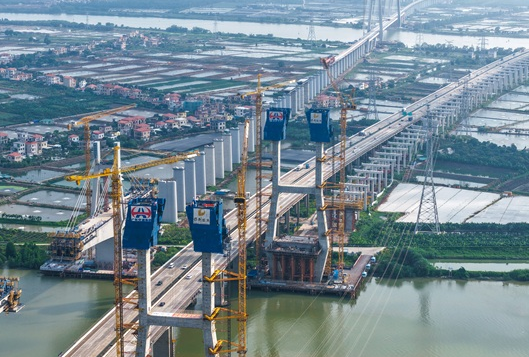
Each pylon of the Xiaolan Waterway Bridge is built across 19 segmented construction lifts, featuring a rectangular hollow cross-section anchored on bearing platforms and bored cast-in-situ pile foundations. Teams overcame a set of complex construction constraints, including elevated working hazards, irregular structural cross-sections, stringent geometric alignment tolerances and high aesthetic standards for exposed concrete surfaces. Engineering teams rolled out targeted technical breakthroughs and deployed fully automatic hydraulic climbing formwork systems. The apparatus allows formworks to rise progressively alongside pylon construction, drastically cutting risks associated with high-altitude lifting and hoisting work.
On-site construction follows a strict operational framework of layered concrete pouring, staged formwork ascent and full-cycle real-time monitoring. Every procedure covering formwork joint assembly, concrete temperature control, vibration compaction and curing receives granular oversight, guaranteeing dense internal structures and uniform exterior finishes for pylons with fabrication accuracy held to millimetre tolerances.
Steel anchor beams represent a critical precision-sensitive component that bears core structural loads, where minor installation deviation would compromise overall bridge stress safety. To address obstacles including heavy component weight, confined high-altitude working zones and rigid bilateral symmetric load-bearing requirements, engineering teams refined construction drawings well in advance. A combined workflow of precision hoisting, three-dimensional fine adjustment and continuous monitoring is implemented. Pre-assembly of steel components optimises hoisting trajectories, while dedicated survey teams carry out cross-check calibration on elevation, central axis and horizontal flatness indicators. The process enables one-shot accurate positioning of steel anchor beams, creating a stable base for subsequent stay cable mounting and main girder fabrication.
All sub-projects along the Guangzhou-Zhuhai widening scheme maintain steady construction progress. Donghe Bridge has entered upper structural building phases, three segments of pylon columns at the Xiaohengli Waterway Bridge have been completed, and renovation works at the western zone of Zhongshan Service Area move into final finishing stages. Site teams will prioritise scheduled engineering targets over the coming months, wrapping up preparatory works for the opening of the western zone of Zhongshan Service Area in late June and finishing the closure of the Shiqi River crossing section of Donghe Bridge in late December.
Provincial transport authorities keep rolling out a series of motorway expansion and cross-river bridge projects across the Pearl River Delta to strengthen the Greater Bay Area’s interconnected transport grid. Standardised intelligent construction techniques including automated climbing formwork, three-dimensional component prefabrication and real-time structural monitoring gain wider uptake across regional infrastructure sites. Additional investment flows into trans-waterway crossing engineering, which supports efficient movement of personnel and goods between cities on the east and west banks of the Pearl River Estuary. Ongoing technical research will refine lightweight high-precision construction technologies applicable to coastal river-crossing bridges, supporting the delivery of further major transport links across the delta region.
热门内容推荐