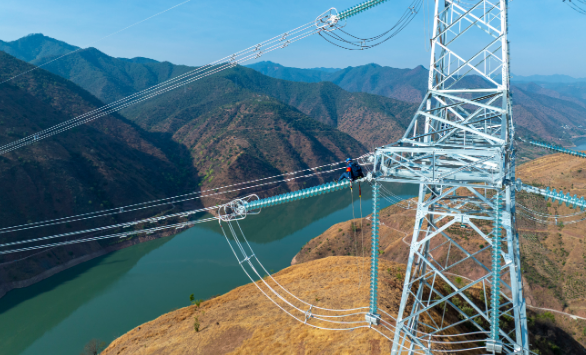
CCCC Delivers Integrated Land Improvement, Smart Farming and Grain Storage Schemes to Safeguard National Food Security
According to China Communications News, China Communications Construction Group undertakes a portfolio of landmark infrastructure schemes focused on land rehabilitation and grain production capacity expansion, transforming barren wasteland into fertile arable land and shifting rain-fed primitive cultivation to digitally managed precision farming. Four core development strands – ecological restoration, upgraded agricultural infrastructure, integrated resource allocation and technological innovation – form a full-industry-chain framework to reinforce domestic food supply resilience.
Ecological Restoration Transforms Barren Terrain into Productive Farmland
Vast stretches of western Alxa desert in Inner Mongolia host neatly arranged straw checkerboard sand barriers, with saplings of Haloxylon ammodendron planted at each grid centre under the West Alxa Phase II project delivered by CCCC First Highway Engineering Co. Once the drought-resistant shrubs mature, branches will be grafted with Cistanche deserticola, a valuable traditional medicinal herb native to China. Covering more than 2.5 million mu across Right Banner Alxa and Ejina Banner, the scheme rolls out artificial grass seeding, afforestation, degraded woodland rehabilitation and engineered sand fixation to rebuild damaged desert ecosystems.
Early construction phases encountered technical hurdles around checkerboard sizing. Oversized grids create deep wind erosion hollows that undermine seedling survival, while undersized barriers fail to form concave wind-damping surfaces and collapse rapidly under sandstorms. Field surveys, meteorological sampling and soil analysis guided engineering teams to finalise a uniform 1.5-metre square grid specification. This dimension generates smooth concave planes to decelerate near-ground wind speeds, trapping drifting sand particles and prompting sediment deposition within each cell. As straw barriers degrade gradually, mature Haloxylon stands take over long-term wind-breaking and sand retention functions. The dual model of shrub forestry plus medicinal crop grafting curbs sandstorm frequency, restores desert ecology and opens stable income streams and local employment for pastoral households.
Ecological rehabilitation work extends from arid desert landscapes to water-rich river and lake zones in eastern China. Decades of neglected fish ponds along Shedu Port in Wuxi once deteriorated into heavily polluted stagnant waterways with discoloured water columns, a challenge resolved by the Taihu Lake (Zhushan Lake) ecological dredging project developed by CCCC Tianjin Dredging Co. The project excavates 1.5 million cubic metres of lake silt, repurposing sediment to fill abandoned fish ponds and resolve water contamination in a single coordinated intervention.
Fine-grained Taihu silt presented fresh technical barriers to solidification and agricultural conversion, compounded by dense reed growth across proposed storage yard zones. Iterative laboratory trials refined vacuum preloading processes alongside proprietary high-permeability plastic drainage panels to lift silt bearing capacity. Native reed vegetation is repurposed as layered permeable bedding to sustain consistent soil drainage and structural continuity for crop cultivation. Seventeen months of round-the-clock construction converted over 1,000 mu of silt marsh into high-yield farmland. Local agricultural authorities calculate annual grain output growth of 600,000 kilogrammes based on an average yield benchmark of 600 kilogrammes per mu.
Upgraded Agricultural Infrastructure Unlocks Production Potential
Longling Village within Xiaojichang Town, Qixingguan District of Bijie in Guizhou hosts expansive sorghum plantations developed under the high-standard farmland scheme built by CCCC First Highway Engineering Co. The integrated development package covers mechanisation-ready field reconstruction, irrigation and drainage networks and comprehensive farmland upgrading, spanning 21 villages and communities across three townships in Qixingguan District. Works deliver 35,000 mu of newly renovated high-grade farmland, alongside 13,500 metres of small-scale irrigation ditches and 135,000 metres of field access roads. Fragmented scattered plots are consolidated into level contiguous farmland, muddy rural tracks replaced with paved agricultural haulage routes and ageing drainage channels fully refurbished.
Residents of Hewei Village previously faced impassable mud tracks that blocked agricultural machinery access during wet weather, creating deep wheel ruts that damaged young seedlings and caused massive post-harvest losses. Widened paved farm roads now accommodate large-scale harvesters and delivery vehicles, supported by interconnected water-saving irrigation networks across consolidated plots. Mechanisation rates within the project zone stand 15 to 20 percentage points higher than surrounding unimproved land, alongside marked gains in the efficient use of water, fertiliser and pesticides. Per mu grain output rises by 10 to 20 per cent, lifting farm household disposable income from agricultural produce.
In Yanjin County, Xinxiang, Henan, a 25,000-mu demonstration zone for high-standard farmland built by CCCC First Navigation Engineering Co. integrates four interlinked systems: production infrastructure, ecological protection, intelligent agriculture and field management. A unified network of field roads, drainage channels, water wells, power lines and crossing bridges is constructed, paired with an agricultural IoT intelligent management hub supported by big data and cloud computing platforms. Real-time field sensor data drives automated irrigation and variable-rate fertilisation, synchronising crop growth cycles to uniform industrial standards and cutting labour, water and fertiliser input volumes. Engineering crews dredge and line 17,000 metres of drainage channels linked to newly drilled water wells to form an efficient irrigation grid. Fixed sprinkler rigs, integrated water and fertiliser dosing equipment and soil moisture regulators cover the full 25,000 mu development zone, with customised growing environments tailored to local wheat, maize and peanut rotational cropping cycles to establish intensively managed modern farm complexes.
Optimised Resource Integration Boosts Cultivation Efficiency
Yongsheng Town in Jiangyou City, Sichuan, accommodates a high-quality forage, grain and vegetable planting base delivered by CCCC First Highway Engineering Co., covering a total site area of 800,000 square metres. The complex incorporates eighteen functional zones including seedling breeding hubs, field research laboratories, ecological grain silos, integrated rice-crayfish cultivation zones and landscape retention ponds, with projected annual rice and rapeseed output reaching 13 million kilogrammes upon full completion. The project adopts co-operative land contracting frameworks to consolidate fragmented smallholder plots, deploying contemporary agronomic techniques to lift land utilisation and crop yields and deliver shared economic returns for participating farming households.
Local soil degradation challenges including acidification and nutrient leaching are addressed via customised soil remediation formulas combining biochar, calcium hydroxide and modified biochar composites deployed across rehabilitated high-standard farmland. Laboratory test results confirm modified biochar stabilises soil pH within optimal growing ranges, elevating retention capacity for ammonium nitrogen and available phosphorus by more than 30 per cent while enhancing soil aggregate formation, water storage and fertiliser retention capacity.
Once baseline soil fertility targets are achieved, circular ecological production frameworks are rolled out across the base centred on integrated rice and crayfish rotational farming. Aquatic crustaceans consume field weeds and pest larvae, with organic waste deposits acting as natural fertiliser to improve rice grain quality. The dual-use model delivers simultaneous harvests of cereal grain and aquatic produce on unified land parcels to expand household revenue streams.
Technological Innovation Strengthens National Grain Storage Capacity
Tangshan’s national grain storage and logistics complex in Hebei stands as the city’s first state-level grain reserve facility, with a total construction footprint of 36,600 square metres. The multi-functional compound unifies grain procurement, long-term reserve storage, cross-regional distribution, processed food manufacturing and wholesale trading, housing 27 independent silos with a combined static grain holding capacity of 300,000 tonnes. Rigorous technical standards govern waterproofing, air tightness, damp proofing and pest control for bulk grain storage, addressed through energy-efficient automated mechanical ventilation systems that dynamically regulate internal temperature and humidity levels. A full-spectrum intelligent grain depot management platform enables automated stock handling, perimeter security monitoring and continuous grain condition tracking, delivering real-time operational data for system performance evaluation, fault diagnostics and operational optimisation.
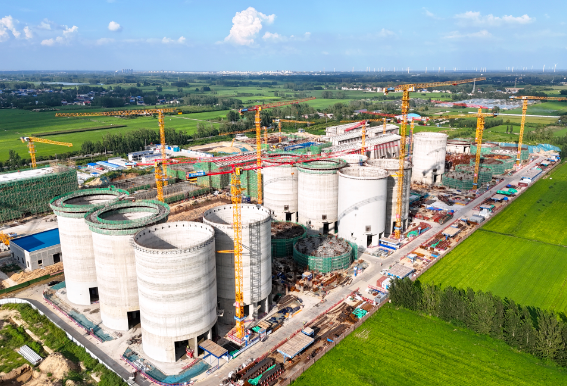
A large-scale grain reserve project under construction in Zhengzhou, Henan, achieves a total designed storage capacity of 668,000 tonnes, sufficient to meet staple food consumption demand for approximately 20 million people over a full calendar year. The segment developed by CCCC First Highway Engineering Co. accounts for 446,000 tonnes of total silo volume, comprising large-diameter bulk grain silos and a site-wide intelligent storage control ecosystem. Recognised as the nation’s first fully digitalised grain reserve complex, the integrated monitoring platform powered by IoT, big data and artificial intelligence delivers complete, real-time oversight of stored grain stocks across all facility zones. Eight interconnected intelligent subsystems including distributed grain temperature sensors, automated pest detection modules and adaptive ventilation units support low-energy, low-emission green grain preservation operations. On-site dust suppression infrastructure and enclosed nitrogen-controlled storage systems maintain clean working environments and reduce overall energy consumption, while integrated grain crushing reduction equipment cuts grain breakage rates by roughly two per cent to preserve stored commodity quality.
Independent agricultural infrastructure research bodies track replicated deployment of CCCC’s integrated land restoration and smart storage technologies across provincial high-standard farmland and grain reserve development programmes. Cross-regional engineering co-ordination mechanisms streamline cross-provincial resource allocation for desert rehabilitation, lake silt reclamation and automated grain storage construction schedules throughout successive development cycles.
热门内容推荐