Yunnan Builds China’s First Ex Situ Conservation Sites for Rare Plant Species Along Motorway Corridors
According to Xinhua News Agency, integrated practices that balance transport infrastructure construction and ecological conservation have delivered landmark progress in Yunnan. Two demonstration zones dedicated to ex situ conservation of indigenous plant species with minimal surviving populations have been completed alongside Kunming-Anning Expressway Gaoyao section and Muyuan-Yuanmou Expressway Yangjie section, developed by Yunnan Communications Investment & Holdings Group. More than 10,000 seedlings covering 31 rare species, including Parashorea chinensis, Michelia magnificum, Firmiana major and Paradombeya sinensis, have been transplanted to the sites, marking the first nationwide scheme that systematically integrates the protection of critically scarce wild plants into roadside ecological restoration along major motorways.
Working alongside Kunming Institute of Botany under the Chinese Academy of Sciences, a three-mu dedicated conservation garden has been constructed beneath the Gaoyao interchange on the Kunming-Anning Expressway. The garden hosts rare flora often described as “giant pandas of the plant world”, such as Parashorea chinensis, Pinus squamata and Craigia yunnanensis, and operates as a multi-functional space for species preservation, academic research, public science communication and environmental education. Motorway travellers passing through the interchange gain direct exposure to Yunnan’s exceptional biological diversity via the landscaped conservation zone.
Design work for the Yangjie stretch of Muyuan-Yuanmou Expressway responds specifically to the fragile arid river valley ecosystem of the locality. Local drought-resistant indigenous varieties including Firmiana major, Paradombeya sinensis and Hibiscus aridicola have been selected to trial innovative ecological restoration technologies. Firmiana major, once thought extinct in wild habitats and now classified as a national Class II protected wild plant, has seen a 91 per cent survival rate among its first batch of seedlings transplanted from February 2026 onwards, verifying the reliability and practicality of the established technical framework for roadside conservation work.
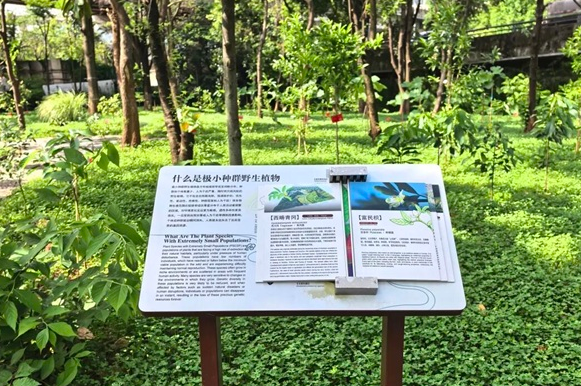
Roadside landscaping along motorways has long presented persistent operational hurdles, especially within arid river valley terrain, where steep slopes suffer low seedling survival rates and carry heavy long-term maintenance costs. The newly launched conservation model repurposes roadside greenfield land into germplasm resource hubs for rare minimal-population wild plants. Technical planning draws on the natural resilience of native flora, which thrive under drought, intense heat and nutrient-poor soil conditions, lifting overall plant survival performance significantly. Traditional roadside greening operations focused solely on surface vegetation coverage are upgraded into composite projects that combine ecological rehabilitation with biodiversity safeguarding, opening new avenues for targeted protection of scarce plant species across Yunnan and wider regions of China.
Since Yunnan published its official rescue and conservation framework for minimal-population wild plants covering 2010 to 2020, alongside an urgent five-year action plan, a total of 274 plant varieties have been incorporated into national and provincial protection schedules. Systematic research and comprehensive preservation programmes have been rolled out for more than 100 of these species, with over 30 varieties such as Parashorea chinensis, Acer yangbiense and Craigia yunnanensis removed from critical extinction risk brackets. National-level rescue initiatives for minimal-population wild plants continue to generate tangible biodiversity conservation outcomes across China.
The pioneering deployment of dedicated rare plant conservation systems within motorway roadside zones delivers replicable practical approaches that reconcile transport development with ecological stewardship. The project establishes a transferable Yunnan model for the national transport sector to engage systematically in biodiversity preservation, with highway networks across other provinces able to adapt the technical and operational frameworks for their own roadside ecological upgrading schemes.
热门内容推荐