Scientific Breakthrough Fills Evolutionary Gaps: China Confirmed as the "Eastern Cradle" of Early Vertebrates
On March 5, 2026, a research team from the Chinese Academy of Sciences published two papers simultaneously as cover articles in the international journal Nature, announcing the latest breakthrough findings in the study of osteichthyes (bony fish) origin. The research successfully filled key gaps in the evolutionary process from "fish to human" and further confirmed that China is the "Eastern Cradle" of early vertebrate evolution, demonstrating China’s profound accumulation and leading strength in the field of paleontological evolution research.
Osteichthyes are the core backbone of vertebrate evolution. Their two existing major lineages—ray-finned fish and lobe-finned fish—occupy a wide range of ecological niches in water and on land, with one branch of lobe-finned fish evolving into all tetrapods, including humans. For a long time, the origin of osteichthyes has remained an unsolved mystery in academic circles. The core challenge lies in the lack of fossil information on primitive osteichthyes (stem osteichthyes) before the divergence of ray-finned and lobe-finned fish, making it impossible for academics to clarify the morphological characteristics of their closest common ancestor and hindering a complete understanding of the early evolutionary history of vertebrates.
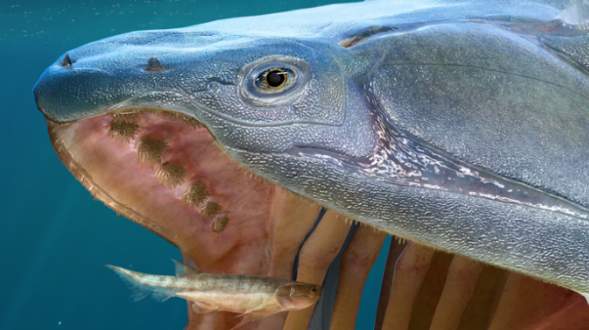
After long-term field exploration and laboratory research, the research team successfully discovered the earliest known osteichthyes fossils, systematically revealing the morphological characteristics and key anatomical details (such as jaws, teeth and braincase) of two primitive osteichthyes, and solving long-standing evolutionary puzzles. The team found the world’s earliest complete osteichthyes fossil—Eoosteichthys chongqingensis—in the early Silurian strata of Xiushan, Chongqing. Meanwhile, in the late Silurian strata of Qujing, Yunnan, they used high-resolution CT imaging technology to detailedly analyze the complete cranial structure and tooth morphology of Megamastax amblyodus, the largest vertebrate in the Silurian period, successfully solving the half-century-old puzzle of the "tooth pad" attribution.
Living 436 million years ago, Eoosteichthys chongqingensis was only 3 centimeters long but preserved intact from head to tail. Its age is not only earlier than previously known large osteichthyes fossils, but also older than the earliest known osteichthyes microfossils. This small ancient fish had both primitive and advanced characteristics: its streamlined body, single dorsal fin and spiny scales were similar to early ray-finned fish, but it lacked the characteristic lepidotrichia of osteichthyes and had anal fin spines only found in chondrichthyes (cartilaginous fish) and placoderms. This discovery confirmed that the combination of core osteichthyes characteristics formed much earlier than previously recognized, reshaping the traditional understanding of early osteichthyes evolution.
In sharp contrast to Eoosteichthys chongqingensis, Megamastax amblyodus, found in the late Silurian (about 423 million years ago) strata of Qujing, Yunnan, was over 1 meter long, making it the largest known vertebrate in the Silurian period. After nearly a decade of exploration and dozens of attempts, the research team used advanced imaging technology and computer 3D reconstruction and restoration to successfully restore its complete 3D cranial structure and internal anatomical characteristics. The study found that Megamastax amblyodus had teeth arranged in two rows (inner and outer), with the "tooth pad" in the inner row associated with unique tooth sockets, confirming it as a primitive tooth row characteristic of osteichthyes. Meanwhile, this structure solved the mystery of the attachment of scattered tooth pad fossils found in Silurian strata of the Baltic Sea half a century ago, clarifying the attribution of such peculiar teeth.
Phylogenetic analysis clearly classified these two ancient fish into stem osteichthyes, representing primitive forms before the divergence of ray-finned and lobe-finned fish. They clearly revealed the morphological characteristics of the closest common ancestor of osteichthyes—among which ray-finned fish evolved into most of today’s fish, and lobe-finned fish evolved into humans and other tetrapods, filling a key link in the evolutionary chain from "fish to human".
The research results not only enriched academic understanding of the early radiation evolution of gnathostomes (jawed vertebrates), negated the traditional speculation that "osteichthyes ancestors were closer to lobe-finned fish", and clarified the evolutionary trajectory of jaws and teeth in early osteichthyes, but also further confirmed that southern China is the "cradle" of osteichthyes and even all gnathostomes. This breakthrough provides precious fossil evidence for global research on early vertebrate evolution, promotes the academic circle to re-examine the early evolutionary process from "fish to human", and injects new momentum into the sustainable development of China’s paleontological research field.