Breakthrough in Quantum Dot Display Technology Achieved by Fuzhou University and Mindu Innovation Laboratory
Fuzhou University, in collaboration with Mindu Innovation Laboratory, has made a significant breakthrough in the field of ultra-high-definition integrated display technology, according to People’s Network. Led by Professor Li Fushan’s team from the College of Physics and Information Engineering at Fuzhou University, the research group has successfully developed an ultra-high-resolution quantum dot display technology for Augmented Reality (AR) and Virtual Reality (VR) applications. The relevant research paper was published in the world’s top academic journal Nature at Beijing time on April 2.
Professor Li Fushan explained that with the rapid development of technologies such as AR and VR, display devices are evolving towards higher resolution, more realistic colors and longer service life. Among these, “retina-level display” — with a pixel density exceeding 10,000 — is regarded as a key goal. However, when pixel sizes are reduced to the micrometer or even nanometer scale, traditional methods struggle to prepare patterns precisely, leading to easy color interference and a significant decline in device performance, which has become a core bottleneck restricting the industry’s development.
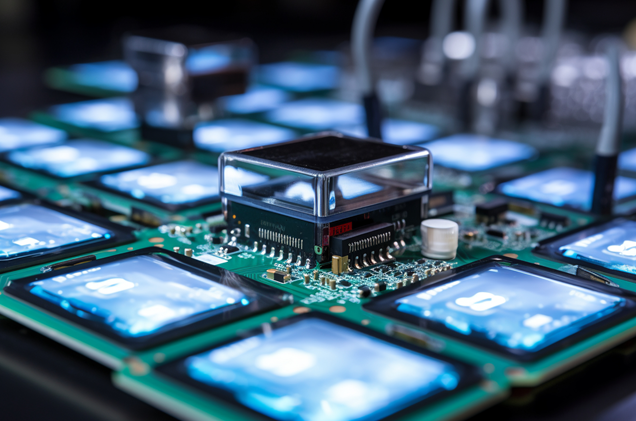
To address this challenge, the research team proposed a new nanomanufacturing method that enables the “precision printing” of luminescent materials at an extremely small scale, constructing high-precision red, green and blue pixel arrays with almost no defects. Meanwhile, by optimizing the material distribution, the luminescence becomes more uniform and stable, and structural design effectively avoids interference between different colors, significantly improving display quality. The team also introduced nanomaterials to regulate the interior of the devices, greatly enhancing their efficiency and service life.
Lin Lihua, a young teacher at Fuzhou University and the first author of the paper, introduced that supported by a series of technological innovations, the red light device developed by the team has an efficiency of 26.1% and a service life of more than 60,000 hours, while the performance of green and blue light devices has also been significantly improved. Furthermore, the research team integrated this technology with integrated circuits to develop a prototype integrated display that can control each pixel individually, realizing dynamic image display and providing a new path for the development of high-end integrated display chips.
Experts pointed out that this achievement provides important support for China’s independent development in the field of next-generation integrated display and related chip technologies. As a cutting-edge nanomaterial, quantum dots are known for their ability to accurately and vividly restore colors according to light wavelengths, and their integration into display panels has become a key indicator of technological progress in the high-end display industry.