Chinese Embodied Intelligence Robots Make Strides in Generalization and Commercialization
“Put the garbage on the transparent plate.” At Zibianliang Robot Company, the “Quantum No.1” robot begins to act upon receiving this instruction, a vivid demonstration of the progress China has made in embodied intelligence technology.
As industry insiders heatedly debate when embodied intelligence will reach its “ChatGPT moment”, a consensus is emerging: enhancing the generalization ability of embodied intelligence to better serve humans in diverse scenarios is the key priority.
A recent survey of several embodied intelligence enterprises in Shenzhen by China Securities Journal has found that with technological breakthroughs and improved general capabilities, embodied intelligence robots are becoming smarter and more capable.
“‘Put the garbage on the transparent plate’ is a relatively vague instruction that requires the robot to understand and judge for itself what constitutes garbage and what a transparent plate is,” Yang Qian, co-founder and chief operating officer of Zibianliang Robot, explained the ingenuity behind the command.
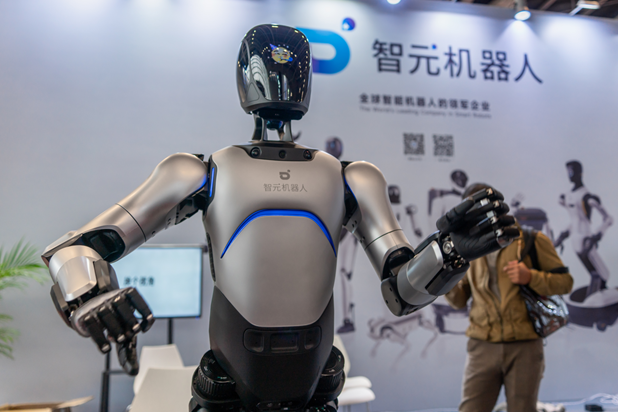
Witnesses observed the “Quantum No.1” use its gripper to pick up paper balls, fruit peels and waste paper cups from the workbench and place them accurately on the transparent plate, while leaving other items such as ceramic cups and toys untouched.
Yang Qian noted that after extensive training, the robot has gradually gained the ability to understand the physical world. The company’s goal is to enable robots to think and work like humans in the complex and random physical world based on a general brain, rather than just performing pre-programmed tasks.
Such technological breakthroughs have achieved promising progress. Last March, Zibianliang partnered with 58 Tongcheng in Shenzhen, with 58 Daojia platform randomly dispatching cleaners to work alongside robots in housekeeping services. As a capable assistant to cleaners, the robots can complete complex tasks such as tidying desktops and collecting garbage.
Improved generalization ability also helps meet user needs precisely. Take hotel delivery services as an example: while hotel delivery robots are common in China, they face restrictions in many overseas countries and regions where elevator control modification is not allowed, hindering the application of cross-floor service robots.
To address this, Pudu Technology launched the humanoid-like embodied intelligence service robot “Shandianxia Arm”, which adds a robotic arm and dexterous hand to traditional hotel delivery robots. By pressing elevator buttons with its dexterous hand, it solves the elevator control modification problem for robot deployment in overseas hotels.
Focusing on the commercial service sector, Pudu Technology has laid out four product lines, including delivery robots for restaurants and supermarkets, commercial cleaning robots with the largest sales volume and widest application scenarios, industrial handling robots with a load range of 150kg to 600kg, as well as various other embodied intelligence products such as humanoid robots and robot dogs.
Notably, Pudu Technology has achieved large-scale product deployment through its mature commercial capabilities. To date, the company’s robot shipments have exceeded 120,000 units, with overseas revenue accounting for over 80% for consecutive years. “In the coordinate system with revenue on the horizontal axis and profit on the vertical axis, we are one of the few enterprises in the industry located in the first quadrant,” said Zhang Tao, founder and CEO of Pudu Technology.
Explaining the reasons for the company’s successful commercialization, Zhang Tao stated that the stable shipment volume of the full product matrix has generated a large amount of real-machine data, facilitating further model training. Meanwhile, the global sales and after-sales service network has laid a solid foundation for its commercial deployment, allowing the company to sell new products worldwide as soon as they are developed.
For embodied intelligence enterprises, to complete the ecological chain of “technological R&D - scenario verification - commercial closed loop”, in addition to their own innovative breakthroughs, strong policy support is indispensable.
As an industrial cluster, Shenzhen has issued the “Shenzhen Action Plan for Technological Innovation and Industrial Development of Embodied Intelligence Robots (2025-2027)”, which clearly sets the goal of having more than 1,200 enterprises related to the embodied intelligence robot industrial cluster by 2027, and proposes a number of measures to lead technological breakthroughs and build an innovative ecological environment.