Humanoid Robots Break Half-Marathon Record, Highlighting China’s Embodied Intelligence Leap
On April 19, in Yizhuang, Beijing, a 21.0975-kilometer half-marathon track witnessed history — a humanoid robot finished the race in 50 minutes and 26 seconds, breaking the human world record. From stumbling and frequent falls last year to over 100 robot teams competing side by side this year, with more than 40% using autonomous navigation, humanoid robots have achieved a leap from “learning to run” to “running fast, steadily and independently” in just one year, mapping the evolutionary path of the embodied intelligence industry from laboratories to broader application scenarios.
“We never expected the robots to run so fast when preparing for the race,” Liang Hongjun, deputy director of the Equipment Department of Beijing Municipal Bureau of Economy and Information Technology, said in an interview with China Securities Journal after the race. “There will definitely be such pleasant surprises next year, beyond our expectations.”
Last year’s inaugural humanoid robot half-marathon saw many robots struggling to stand, most relying on manual remote control, with the champion “Tiangong Ultra” finishing in 2 hours and 40 minutes. This year, most robots not only stood steadily but also ran fast, with significantly improved autonomous generalization intelligence to cope with road conditions. Honor’s autonomous navigation robot “Shandian” (Lightning) won the championship in 50 minutes and 26 seconds, surpassing both last year’s race record and the human half-marathon world record of 57 minutes and 20 seconds.
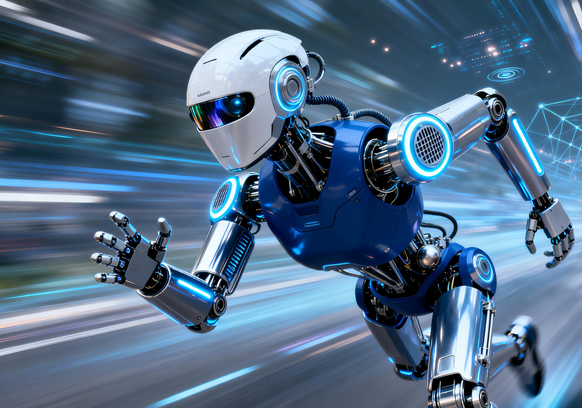
Speed is the most intuitive indicator of technological progress, supported by core components and motion control algorithms. Liang Hongjun noted that the champion Honor “Shandian” has a maximum motor output torque of 600Nm, compared with about 420Nm for last year’s participants. In terms of battery life, it only needed one battery change during the race, with a single battery supporting over 10 kilometers, double the 4 to 5 kilometers of last year’s models.
The robot’s overall structural design and motion control algorithms have also been optimized. Honor team engineers told China Securities Journal that the robot’s reliability has been improved, with an optimized structure, long-leg design and lightweight body boosting its speed. It also adopts liquid cooling technology accumulated by Honor in the mobile phone field to solve overheating problems.
Notably, over 40% of teams adopted autonomous navigation this year, ending last year’s “remote control-dominated” situation. Beijing Humanoid Robot Innovation Center’s self-developed “Embodied Tiangong Ultra” finished in 1 hour and 15 minutes in full autonomous mode without manual intervention, demonstrating mature multi-sensor fusion positioning and real-time dynamic decision-making algorithms.
The outstanding performance of humanoid robots in the race is supported by industrial chain collaboration. Honor, a dark horse in the robot industry, swept the top three, thanks to its accumulated mobile phone supply chain manufacturing capabilities. Lens Technology stated that it built the body of Honor’s participating robots, providing 132 core metal structural parts covering key motion units with high-strength steel for durability and lightweight. Other enterprises including Aobi Zhongguang, Hesai Technology and Landian Touch also provided core components.
Despite remarkable progress, industry insiders acknowledge challenges remain for large-scale commercialization. Liang Hongjun pointed out that robots still lack “three-proof” technology and standardization, which hinders mass production and cost reduction. Peng Zhihui, president and CTO of Zhiyuan, noted a huge data gap is the biggest obstacle to improving robot intelligence.
Industry insiders predict that with continuous technological breakthroughs, policy support and expanded application scenarios, 2026 is expected to be a key year for the commercialization of embodied intelligence, which will better empower various industries.