Chinese Robot Industry Posts Strong Q1 Growth Driven by Embodied Intelligence Boom
Listed companies along China’s robot industrial chain have successively released their Q1 2026 financial reports in recent weeks, with many recording robust growth in both revenue and net profit, a positive sign of the sector’s accelerating development amid booming demand for embodied intelligence and manufacturing automation.
Zhu Keli, founding director of the Guoyan New Economy Research Institute, told Securities Daily that the performance growth across the robot industrial chain stems from the combined effect of rising industry prosperity and resonance between demand and supply sides. “On one hand, the release of demand for automation upgrading in manufacturing, coupled with a recovery in orders from sectors such as 3C, automotive and lithium battery, has driven up the demand for industrial robots,” he explained. “On the other hand, the emerging track of embodied intelligence has brought incremental demand, and domestic component enterprises have seized the opportunity to jointly promote profit recovery.”
Specific financial data from listed companies underscores this upward momentum. On April 22, Suzhou Green Harmonic Drive Technology Co., Ltd. announced that it achieved 140 million yuan in operating income in Q1 2026, a year-on-year increase of 42.96%, while its net profit attributable to shareholders of listed companies reached 32.6341 million yuan, up 61.17% year-on-year. The company stated in its announcement that the performance growth was mainly due to its increased market share in the industrial robot industry, significant expansion of its embodied intelligence robot business and improved production and operation efficiency.
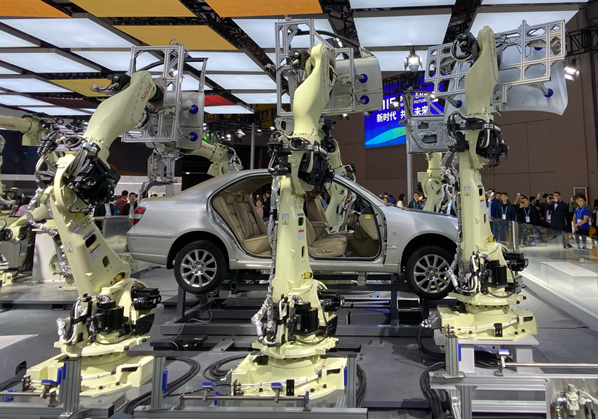
On the same day, Guangdong Topstar Technology Co., Ltd. reported even stronger growth. Its Q1 operating income hit 538 million yuan, a year-on-year surge of 48.53%, and its net profit attributable to parent company soared by 1147.36% to 48.0833 million yuan. Notably, the revenue of its industrial robot and automation application system business rose by 81.20% year-on-year, becoming a key pillar of its high growth.
Shenzhen Leadshine Technology Co., Ltd. also maintained steady growth in the first quarter. It achieved 525 million yuan in operating income (up 34.55% year-on-year) and 72.1203 million yuan in net profit (up 29.20% year-on-year). The company noted in its announcement that it has focused closely on the core needs of mainstream customers in the mobile robot track, strengthened joint R&D and in-depth cooperation with leading industry manufacturers, and made significant market breakthroughs in robot-related businesses such as frameless torque motors and high-degree-of-freedom dexterous hands, leading to a marked increase in order scale and customer coverage.
Despite the strong performance of many enterprises, embodied intelligence remains in the early cultivation stage, industry experts warned. Zhu Keli pointed out that some enterprises have achieved small-batch shipments of humanoid robots, which have been first applied in industrial scenarios and gradually piloted in service scenarios, but the overall scale remains limited. “While supporting systems and software are advancing, with rapid iteration in large models, control systems and algorithms, commercialization still requires time,” he added.
Wu Wanying, senior researcher at Tianyi Digital Economy Think Tank, told Securities Daily that the current industrial stage of embodied intelligence is characterized by forward-looking expectations, dominated by small-batch demand. “The real inflection point for large-scale development will come only when the mass production scale of downstream complete machines crosses the 10,000-unit threshold,” she said.
Public data shows that the domestic embodied intelligence track recorded more than 50 financing deals in Q1 2026, involving over 30 enterprises with a total financing amount of about 20 billion yuan, a year-on-year increase of nearly 60% and a record high. Many enterprises secured single financing of billions of yuan.
“The accelerated financing will act as an accelerator for the industrial chain,” Zhu Keli said. “Start-ups will speed up R&D and mass production with the funds obtained, and upstream mature component manufacturers are expected to benefit first, driving order spillover. At the same time, capital inflow will intensify industry competition, promoting technological iteration and cost reduction.”
In terms of performance realization, Wu Wanying believes that the industry will still be dominated by small-batch orders in the short term. If humanoid robots enter the large-scale mass production stage, the related business income of core component enterprises is expected to achieve non-linear growth.
Industry insiders generally hold that with continuous technological breakthroughs and clearer commercialization paths, the medium and long-term growth momentum of the robot industry is expected to be further enhanced. However, attention should still be paid to uncertainties such as technological routes, mass production rhythm and market demand realization. China’s robot industry is steadily moving towards a new stage of high-quality development, with great potential to become a new engine for economic growth, as noted in a recent report jointly published by multiple industry institutions.