A Cup of Tea and a Dim Sum, Cantonese Morning Tea Holds the Warmth of Daily Life
As morning light spills over the eaves of qilou buildings, the old streets of Liwan, Guangzhou, gradually come to life. Elderly residents strolling leisurely greet their neighbors warmly, and the daily greeting "Yum zo cha mei?" (meaning "Have you had your tea?") kicks off a day full of warmth and daily charm in the city. In Guangzhou, this greeting is more than just a casual remark—it has become a symbol of integrating into local life, while "Dak haan jam cha" ("Have tea when you're free") is the most cordial invitation among friends and acquaintances, carrying the warmth and daily vitality of the city.
In Guangzhou, morning tea is far more than just drinking tea; it has long evolved into the most distinctive Cantonese lifestyle, embodying the unique warm temperament of this commercial city. Stepping into any teahouse, a lively and vibrant atmosphere greets you: waiters push carts stacked with bamboo steamers back and forth between tables, and white steam curls up, carrying a rich aroma. Every time a steamer is lifted, a different delicious surprise awaits.
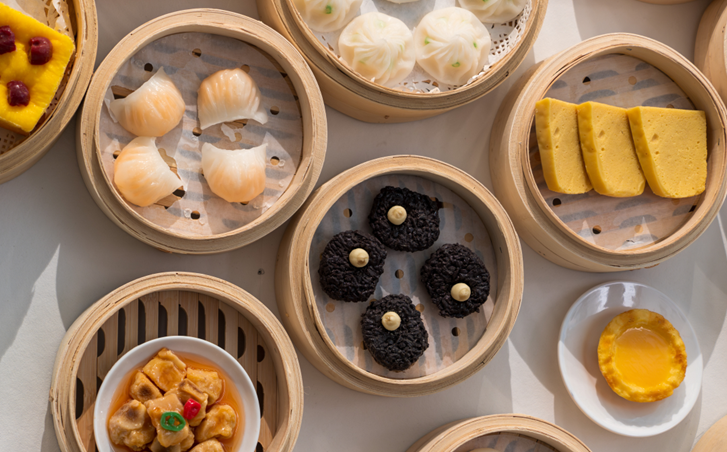
Translucent har gow (shrimp dumplings) have thin, cicada-wing-like wrappers, faintly revealing the pink shrimp inside. Lifted gently, the wrapper trembles but does not break; taking a bite, the fresh soup oozes out, followed by the tender and bouncy shrimp and crisp bamboo shoots. Braised chicken feet in black bean sauce, fried first then steamed, have wrinkled skin soaked in sauce—one bite easily separates the meat from the bones, leaving a sticky, savory taste. Plump char siu bao (barbecued pork buns) have naturally split tops, revealing the sauce-glazed filling inside, with soft and springy wrappers that bring great satisfaction. Besides these, there are numerous dim sums such as turnip cake, rice noodle rolls, siu mai, glutinous rice chicken and boat congee, all dazzling and fully demonstrating the richness and delicacy of Cantonese morning tea.
The ritual of Cantonese morning tea starts with "lang wun" (rinsing the bowl) before pouring tea. Choosing a pot of Pu'er, chrysanthemum tea, black tea or tieguanyin, hot water is continuously supplied, allowing tea drinkers to sit from early morning until afternoon, savoring tea and dim sums in slow time. In teahouses, there are elderly neighbors chatting leisurely, families gathering happily, and businessmen discussing cooperation comfortably. It is both a haven for relatives and friends and a place for workplace communication, holding the most vivid interpersonal interactions in Guangzhou.
This relaxed and lively morning tea culture has a long historical heritage. The predecessor of Guangzhou's teahouses was the "Erli Guan" (Two-Coin Pavilion), which was widespread in urban and rural areas during the Xianfeng and Tongzhi reigns of the Qing Dynasty. With roofs made of bark and frames of bamboo and wood, a few wooden tables and stools formed a resting place, serving coarse tea, plain porridge, fried dough sticks, rice cakes and taro cakes at a price of two coins—affordable for dock workers and construction laborers to fill their stomachs. A folk song of the time testified to its accessibility: "Go to Erli Guan for a cup of tea, only two coins to spend. The cakes are all tasty and filling, truly worth every penny."
During the Guangxu reign, the Thirteen Hongs founded "Sanyuan Lou", the first decent teahouse in Guangzhou, with a magnificent four-story building that made "going to the teahouse" an honorable thing. Later, famous teahouses such as Lin Heung Tea House, Tao Tao Ju and Lu Yu Ju emerged one after another, enriching the morning tea scene in Guangzhou. In the 1920s and 1930s, Lu Yu Ju pioneered "Weekly Featured Dim Sums", launching six sweet and six savory new dim sums every week. Some teahouses also added night tea and singing halls, gradually transforming teahouses from simple catering venues into a "third space" for Guangzhou residents outside of home and work.
After a century of development, the craftsmanship and taste of Cantonese morning tea have been passed down from generation to generation. In 1983, at the first National Food Competition, har gow, siu mai, char siu bao and egg tarts were named the "Four Kings of Cantonese Dim Sum", becoming the benchmark for measuring a teahouse's standard: har gow should be "half-moon shaped with a spider-like belly", with 9 to 11 folds to show craftsmanship; siu mai should have a waist and no top, with hand-chopped, distinct meat filling; char siu bao should be tall and cage-shaped, with a split top revealing a little filling; egg tarts should have crumbly pastry and smooth, creamy filling—every detail reflects the ingenuity of Cantonese dim sum.
To safeguard this warm daily charm and inherit the exquisite craftsmanship, Guangzhou has continuously strengthened the protection of morning tea culture. In May 2022, the "Cantonese Tea-Drinking Custom" was included in the list of provincial intangible cultural heritage representative projects. In January 2026, the "Regulations on the Inheritance and Protection of Guangzhou Morning Tea" was officially adopted, innovatively proposing the classification and labeling of "traditional production" and "non-traditional production", requiring operators to clearly indicate the production method of morning tea food on the menu, and setting a time limit of "no more than 24 hours from production to serving" for traditionally made morning tea, safeguarding the inheritance of morning tea culture.
The setting sun shines through the ancient Manchurian windows, casting a warm glow over the teahouse. A cup of tea fades from strong to light, and a plate of dim sum contains a hundred flavors. In the slow time of Cantonese morning tea, there is not only the joy of taste, but also the warmth of interpersonal relationships and the inheritance of culture. This century-old daily charm is not only a part of Guangzhou residents' daily life, but also the most vivid carrier of Cantonese culture, carrying the city's warmth and memories, becoming more mellow with the passage of time.