Digital Technology Boosts New Cultural Formats in China During Qingming Holiday
BEIJING, April 10, 2026 – During the Qingming Festival holiday, new cultural formats such as digital cultural museums, cloud performances and immersive cultural tourism promoted in many regions have attracted numerous tourists, according to China Culture News. Accelerating the in-depth integration of digital technology with the cultural industry and fostering new cultural formats have become an inevitable requirement for stimulating cultural innovation vitality and nurturing new drivers for cultural development.
In recent years, China’s new cultural formats have maintained a strong development momentum. Data shows that in 2025, new cultural formats contributed 81.6% to the revenue growth of above-scale cultural enterprises, driving an increase of 6.0 percentage points in their operating income. Meanwhile, the integration of "culture + technology" has yielded remarkable results, with digital intelligence deeply reshaping the content production, product forms and industrial organization of the cultural industry. Data, algorithms and computing power have shifted cultural production from experience-driven to human-machine collaboration and precise matching, while digital modeling and virtual reality technologies have made cultural products more immersive, interactive and co-creative.
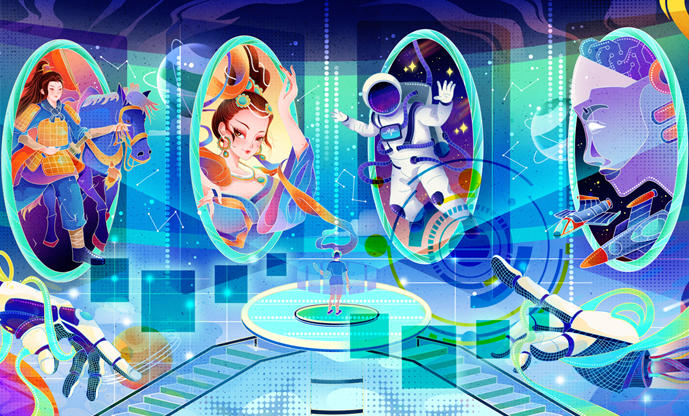
The Yangtze River Delta region has leveraged its Jiangnan cultural heritage to make digital IP developments such as "Jiangnan Hundred Scenes Map" and Kunqu Opera widely popular. Zhejiang Kayo Animation Co., Ltd. has used technologies such as colorful 3D, flocking and temperature change to bring Nezha co-branded cards, which connect traditional cultural IP with intelligent manufacturing, into public consumption. The game "Black Myth: Wukong" has high-precision embedded real cultural relics, buildings and sculpture art into game scenes through digital technology, transforming real cultural heritage such as Chongqing Dazu Rock Carvings and Shanxi Linfen Xiaoxitian into interactive and immersive digital experiences, reviving traditional culture in the virtual space.
"Digital technology is not a ‘soul killer’ that replaces creativity, but an ‘accelerator’ that promotes cultural innovation," said Li Wen, a researcher at the China Cultural Industry Research Institute. These practices fully demonstrate the powerful driving role of digital technology in activating traditional culture and promoting cultural innovation.
While new cultural formats are thriving, there are still shortcomings, such as the need to strengthen value guidance, inadequate integration between technological application and cultural communication, and insufficient exertion of the people’s main role. To address these issues, joint efforts from the government and the market are required.
The formation of new cultural formats needs the two-way coordination of a proactive government and an effective market. Local governments should accurately integrate national strategies with regional development, transform national-level policies on cultural and technological integration through local practices, and build differentiated policy tools in industrial positioning and resource adaptation. A support system oriented to the needs of business entities should be established, providing phased support policies throughout their life cycle to form a resonant effect between policy supply and market demand.
Efforts should be made to promote the coordinated development of digital technology with cultural resource development, precise product reach and immersive scene construction throughout the entire chain of content production, circulation and consumption experience. A value guidance mechanism under technological empowerment should be improved, integrating humanistic spirit and public attributes into the entire process of algorithm recommendation, user profiling and scene design to prevent cultural emptiness, excessive pursuit of traffic and superficiality caused by technological alienation.
Stimulating public creation is crucial to gathering synergy for cultural innovation. Short video platforms, intelligent creation tools and algorithm distribution mechanisms have lowered the threshold for creation and expanded communication channels, enabling the general public to transform from cultural content recipients into participants, creators and communicators. Some platforms have promoted the participation of ordinary users, young inheritors and content creators in intangible cultural heritage communication through algorithm recommendation and interactive feedback mechanisms, vividly reflecting the stimulation of cultural innovation vitality by public co-creation under platform empowerment.
During the Qingming Festival holiday, digital cultural museums in many cities launched online virtual tours, allowing tourists to appreciate cultural relics without leaving their homes. Cloud performances staged by major art troupes were broadcast live online, attracting millions of views. These new cultural formats not only enriched people’s holiday life, but also injected strong vitality into the high-quality development of China’s cultural industry.