Wisteria in Full Bloom at Confucius Temple and Imperial Academy Museum, New Cultural and Creative Products to Launch During May Day
More than 10 centenarian wisteria plants in the Confucius Temple and Imperial Academy Museum have entered their full blooming period, casting a stunning purple veil over the ancient architectural complex. The museum announced on Tuesday that a new series of wisteria-themed cultural and creative products will be launched during the May Day holiday, allowing visitors to take home the beauty of the "purple flower waterfalls".
In the second courtyard of the Confucius Temple, clusters of purple flower spikes in varying shades cascade down like waterfalls, set against the backdrop of red courtyard walls, creating a breathtaking scene. Many visitors have made a special trip to admire this romance. Zhang, a photography enthusiast who has come to take photos of the wisteria here almost every year, is well acquainted with the flowering period. "The wisteria on both sides of the Dacheng Gate blooms most vigorously, making it perfect for photos under the trees," he explained to other visitors while taking pictures. "Going further inside, there are two more plants beside the Dacheng Hall, where you can capture the picture of wisteria reflecting the ancient buildings. The wisteria in the Imperial Academy next to it also has a unique charm."
To respond to visitors’ enthusiasm, the museum has specially launched a "Wisteria Map", which clearly marks the location and flowering period of each wisteria plant in the courtyard, making it easy for visitors to find their way around. Wang Ting, a visitor from Wuhan who came with her friends, said, "We happened to catch the wisteria season. We checked in according to the map and unlocked many hidden photo spots. This trip has been very enjoyable."
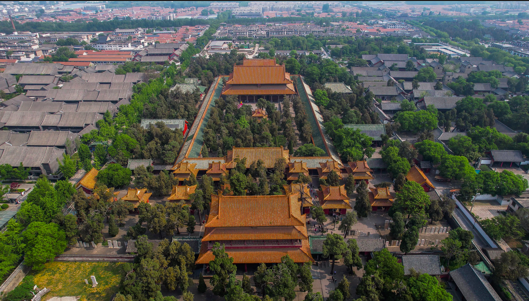
First built in the Yuan Dynasty, the Confucius Temple and Imperial Academy follow the ancient tradition of "temple on the left and school on the right". The Confucius Temple served as a place for emperors to worship Confucius, while the Imperial Academy was the highest central institution of learning in ancient China. Both architectural complexes adopt the traditional Chinese architectural style of being built along the central axis and symmetrical on both sides. Every year when the wisteria blooms, it particularly attracts student groups to take photos. Han, a university student dressed in an academic gown, posed in front of the wisteria while her friend pressed the shutter repeatedly with a mobile phone. "We will graduate in June, so we specially came here to take graduation photos," she said. "It feels like being surrounded by a sea of flowers and scholarly atmosphere. Every random shot is a great photo, full of atmosphere."
In the cultural and creative space of the Imperial Academy, the new wisteria-themed cultural and creative products, which will be officially on sale during the May Day holiday, have been put on display in advance. Staff members introduced that these products take wisteria flowers and core buildings such as the Pi Yong (Imperial Academy Hall) and the Glazed Archway as design elements, covering daily items such as postcards, round fans and refrigerator stickers.
The museum has also launched limited-edition stamps, integrating the silhouettes of wisteria flowers, the Pi Yong Hall and the Dacheng Hall. From April 28 to May 31, visitors can visit two cultural and creative spaces in the museum to collect the stamps.
The Confucius Temple and Imperial Academy Museum is a key cultural relic protection unit in China, which bears important historical and cultural value. The blooming wisteria and the newly launched cultural and creative products not only enrich visitors’ experience but also promote the inheritance and dissemination of traditional Chinese culture.