Chen Zongmao: A Lifetime of Dedication to China’s Tea Industry
“Scientific research must be integrated with production, and achievements must truly benefit tea farmers and boost the industry.” This simple yet powerful statement embodies the unwavering original aspiration of Chen Zongmao, academician of the Chinese Academy of Engineering, who has devoted over 60 years to tea science. Since entering the Tea Research Institute of the Chinese Academy of Agricultural Sciences in 1960, Chen’s life has been closely linked to this small leaf, safeguarding China’s tea industry with remarkable scientific achievements and interpreting a scientist’s deep affection and responsibility for the “national drink” through a lifetime of perseverance.
When Chen embarked on his tea research journey, a major challenge threatened tea farmers’ livelihoods: rampant pests and diseases led to declining tea tree growth and reduced yields. In the 1970s, major tea-producing areas such as Zhejiang and Jiangsu were severely infested by the white peach scale insect. With a waxen shell acting as “protective armor,” the tiny insect attached firmly to tea branches, sucking nutrients relentlessly, and conventional pesticides failed to penetrate its shell.
“During field surveys back then, I often saw tea farmers sighing around withered trees, spraying pesticides repeatedly without success,” Chen recalled. “I was deeply moved and determined to find the insect’s weakness to save their tea gardens.” He innovated a simple detection method, counting insects on cotton plugs sealing test tubes with infested branches, and accurately identified the larval hatching peak—the “golden prevention period” when the wax layer was not yet formed. This method greatly improved control effects in Zhejiang’s tea areas.
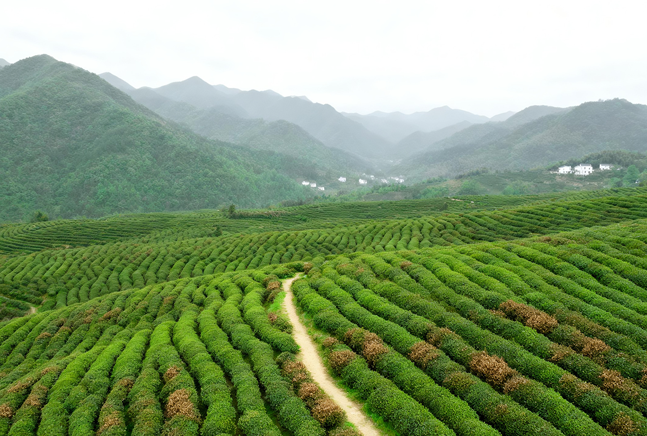
With strong support from the Department of Agriculture and Rural Affairs of Zhejiang Province, Chen established tea plant protection contact points in the early 1970s, extending scientific research to the frontline of production. By the mid-1980s, 74 provincial and 415 county-level monitoring stations had been built, forming a province-wide prevention network that helped increase Zhejiang’s tea output nearly fourfold.
In the 1960s, pesticide residues became a key barrier to China’s tea exports, with strict international standards and a lack of domestic research. Chen took the lead in pioneering pesticide residue research in China. Without advanced equipment, he used mouse blood to detect residues, improving accuracy by 1,000 times, and later adopted gas chromatography for more precise measurements.
His groundbreaking viewpoints—linking pesticide vapor pressure to residue duration and emphasizing tea infusion leaching rate in safety assessment—were adopted by the Food and Agriculture Organization (FAO) in 2004, enhancing China’s voice in global tea standard-setting. His laboratory obtained UK FAPAS certification in 1999, becoming the only EU-recognized Chinese laboratory for tea pesticide residue analysis, helping reduce China’s tea pesticide residue excess rate from 80% in 1999 to 18% in 2007.
In the 21st century, Chen focused on green prevention, pioneering chemical ecology research on tea pests. His team revealed the role of “kairomones” and developed highly effective pheromone lures and eco-friendly pest traps. In 2018, the 85-year-old traveled to Guzhang County, Hunan, guiding the establishment of 1,200-mu green prevention demonstration sites that increased farmers’ income by 1.048 million yuan.
Now in his 90s, Chen still maintains a passion for tea research, reading foreign literature daily and training over 30 postgraduates who have become backbones in the field. “As long as my health permits, I want to do more for tea and see Chinese tea reach a broader world,” he said, his words filled with sincere love that continues to illuminate the future of China’s tea industry.