China’s 2025 Autumn Grain Purchase Concludes with High Output, Quality and Market Vitality
As spring ploughing progresses apace across China, the peak purchasing period for the 2025 autumn grain has drawn to a close. Latest data released by the National Food and Strategic Reserves Administration (NFSRA) shows that grain operators nationwide have purchased more than 320 million tonnes of autumn grain to date, a relatively high level in recent years, with market prices steadily rising and the characteristic of “better quality fetching better prices” becoming more prominent.
The autumn grain harvest has achieved both increased output and improved quality, with market-oriented purchases accounting for over 90 percent of the total. It is understood that the peak purchasing period for medium and late rice in China has concluded, with a total purchase volume of 103 million tonnes; corn purchases reached 210 million tonnes and soybean purchases nearly 13 million tonnes, with corn and soybean purchasing continuing in Northeast and North China.
In Jianlou Village, Jinzhou Town of Ningxiang City, Hunan Province, Huang Yong, a large-scale grain grower, sold out all his 1,200 mu of late rice by the end of last year. “All are high-quality fragrant rice varieties, including Shaoxiang 100, Yuzhenxiang and Nongxiang 42, with a per mu yield of over 400 kilograms and a price of around 155 yuan per 50 kilograms,” Huang noted.
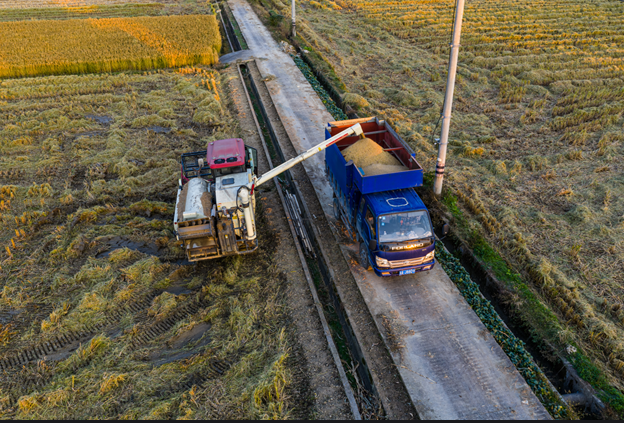
Qu Chen, deputy general manager of China Grain Reserves Corporation Jiansanjiang Direct Warehouse Co., Ltd. in Heilongjiang Province, stated that the company purchased approximately 500,000 tonnes of rice in 2025. “This year’s rice features good quality and appropriate moisture content, boosting farmers’ enthusiasm for selling grain. Diversified purchasers entered the market early, ensuring smooth sales channels and active purchases by traders from other provinces,” he said, adding that the adjustment of rice planting structure—replacing some ordinary round-grain varieties with high-quality ones such as glutinous rice—has accelerated rice sales in the region compared with previous years.
Wang Xiudong, deputy director of the Strategic Research Center and researcher at the Institute of Agricultural Economics of the Chinese Academy of Agricultural Sciences, commented, “Against the backdrop of consecutive bumper harvests, the decline in minimum price purchases to some extent reflects the deepening marketization of China’s grain purchase and sale. Currently, market-oriented purchases account for over 90 percent of total grain purchases, with processing enterprises, traders and reserve warehouses as the main players, especially for high-quality rice which circulates more rapidly in the market.”
High-quality grain has witnessed brisk supply and demand, with high-quality rice and corn enjoying great popularity. Luo Shouquan, director of the Grain Reserve Department of the NFSRA, indicated that the autumn grain purchase market has remained active recently, with various entities actively purchasing grain. Prices of major varieties have risen steadily, particularly for high-quality rice, corn and high-protein soybeans.
In Qingfeng Village, Nandu Town of Liyang City, Jiangsu Province, an enterprise-university cooperative has built a large-scale, standardized planting base for high-quality edible rice varieties. Wang Linsong, head of the base and Liyang Suifeng Agricultural Technology Co., Ltd., said, “Rice sales reached nearly 9,000 tonnes last year, an increase of about 11 percent from the previous year. High-quality rice sells well, with high repurchase rates from downstream suppliers such as catering and supermarkets, increasing the per mu income of cooperative farmers by over 400 yuan.”
Technological contribution rate in grain production has been continuously improving, helping more farmers adopt modern planting technologies. Yu Jia’ao, secretary of the Party Committee of Beidahuang Group Baoquanling Branch, explained that full-chain technological empowerment ensured stable soybean yields despite local drought last year, including full coverage of high-quality varieties, promotion of advanced planting models and precision management through the Internet of Things.
In Baoqing County, Heilongjiang Province, in-depth cooperation between reclamation areas and local governments has formed an “overall trusteeship” model to facilitate the application of integrated technologies. Cui Jihang, head of the Crop Cultivation Management Section of Baoqing County Agriculture and Rural Bureau, said 125 demonstration bases covering 506,000 mu have been built, driving yield and quality improvement of 300,000 mu of corn and soybeans in surrounding areas. All major grain-producing regions have stepped up efforts to link technological promotion with high-quality grain purchase, ensuring farmers’ income increases alongside grain quality improvement.