Spring Farming Blooms at Yuanyang Hani Rice Terraces, the World’s First “Triple Heritage” Site
YUANYANG, YUNNAN – As spring ploughing gets underway across China’s southwestern highlands, the iconic Hani Rice Terraces in Yuanyang County, Honghe Hani and Yi Autonomous Prefecture, are draped in shimmering water, mirroring the sky and clouds above. Along the terraced slopes, Hani villagers tend to the fields—digging plot boundaries, reinforcing ridges, guiding oxen to plough, and bending to transplant rice seedlings—painting a vivid scene of harmony between humanity and nature.
Viewed from a tilt-shift perspective, figures move lightly across the terraces, resembling a miniature pastoral fairyland. In September 2025, the Hani Rice Terraces were inscribed on the World Heritage List for Irrigation Structures, making them the world’s only agricultural site holding three global titles: World Cultural Heritage, Globally Important Agricultural Heritage System, and World Heritage for Irrigation Structures.
Nestled in the southern Ailao Mountains, the Yuanyang terraces span 56,100 mu (≈3,740 hectares) and date back at least to the Tang Dynasty, over 1,300 years ago. They form a sophisticated “four-element integrated system”—forests, villages, terraces, and waterways—that sustains a closed ecological loop: mountain forests conserve water; gravity-fed channels carry it through villages to the terraces; excess water flows to rivers, evaporates, and returns as rain to the forests.
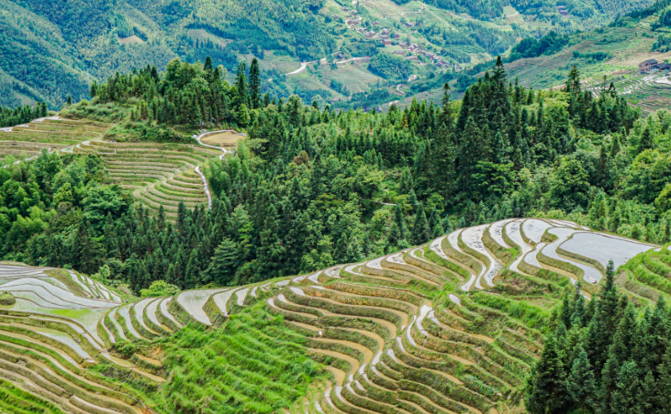
This ancient, damless irrigation network relies on 305 man-made channels and a traditional management system led by “ditch keepers”, or guardians of the watercourses. “We check the channels daily, rain or shine, to ensure fair water distribution across every plot,” said Lu Zhixiang, a 67-year-old ditch keeper from Quanfuzhuang Village, whose family has maintained the canals for generations.
Spring planting here unfolds in rhythm with altitude: transplanting begins in late April and continues through May across the tiered landscape. The terraces’ reflective surfaces, paired with the soft tones of Hani-style architecture, create a striking visual harmony that draws crowds of locals and visitors. Many come to admire the scenery, take photographs, and experience the tranquility of this living heritage.
According to the International Commission on Irrigation and Drainage (ICID), the September 2025 inscription recognized the terraces’ outstanding universal value as an irrigation system that blends ecological balance, cultural continuity, and sustainable farming. The site now stands as a global model for mountain agriculture and cross-generational heritage stewardship.
Local authorities note that spring farming activities this year fully respect traditional methods while maintaining the terraces’ ecological integrity. The “triple heritage” status has boosted both conservation efforts and cultural tourism, supporting rural vitalization while preserving the Hani people’s age-old wisdom of living in balance with the land.
For the Hani community, the annual spring planting is more than agricultural work; it is a ritual that renews their bond with the terraces and honors a way of life preserved over centuries.