Deep-Sea Farming Platforms Drive Lianjiang’s Fishery Transformation
As dawn breaks over Dinghai Bay in Lianjiang County, Fuzhou City, on China’s southeast coast, a farmer tends to his work on the “Dinghai Bay No.2” platform, lifting a nearly one-kilogram large yellow croaker from a deep-sea cage. The fish glistens golden in the early morning light, a sign of its premium quality.
Such fish fetch around 100 yuan per jin at first sale, a stark contrast to the 20 to 30 yuan per jin for those raised in traditional inshore cages. The secret behind this significant price gap lies in the “steel castle” that is the deep-sea aquaculture platform.
Resembling a giant indoor stadium wrapped in massive nets and metal trusses, the “Dinghai Bay No.2” is situated two to three kilometers off the coast. Measuring approximately 60 meters long and 32 meters wide—more than twice the size of a standard basketball court—it boasts a breeding area 17 meters deep underwater, with a water volume exceeding 15,000 cubic meters connected to the open sea, capable of housing 200,000 freely swimming large yellow croakers.
Unlike cramped inshore cages, the platform serves as a “marine ranch,” offering ample space for fish to swim, faster water flow and richer algae and plankton. This environment results in firmer flesh that tastes close to wild counterparts, with daily sales reaching over 10 tons during the spring fishing season, a common routine for those working on the platform.
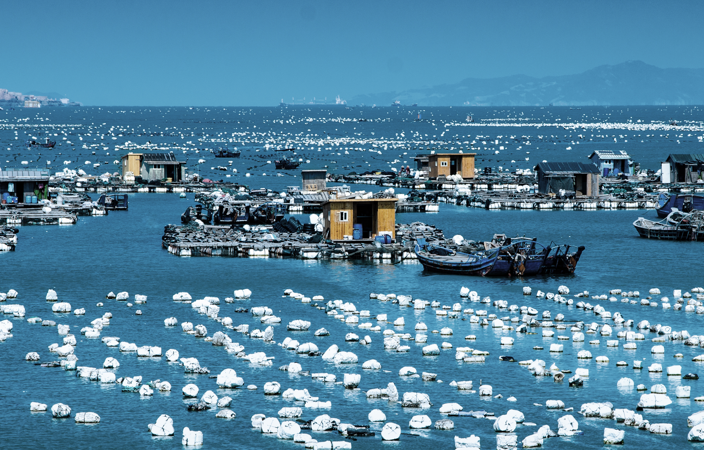
The shift in farming methods has also addressed long-standing challenges of traditional cages, which are prone to damage from barnacles and algae. With a simple press of an electric button, the platform’s giant nets can be flipped out of the water, allowing to fall off naturally in the sun—cutting labor costs by more than half while protecting the nets. It is also more resistant to typhoons and red tides, boosting fry survival rates to over 90 percent.
Lianjiang, with a marine area of 3,112 square kilometers—2.7 times its land area—has long been a leading county in China for aquatic product output and fishery output value. Data from Lianjiang Marine and Fisheries Bureau shows that in 2025, the county’s total aquatic product output reached approximately 1.3983 million tons, with a fishery output value of about 31.212 billion yuan.
To date, Lianjiang has deployed 11 such modern “marine ranch” platforms, the highest number among counties nationwide, producing nearly 2,000 tons of high-quality fish annually with an output value of 400 million yuan. The transformation from inshore cage farming to deep-sea, enterprise-led and technology-driven operations has revitalized the local fishery, boosting related sectors such as fishing, processing, logistics and sales.
In Xiaocheng Town, over 80 percent of the 27,000 residents work in fishery-related industries, and seven out of 11 administrative villages have a collective economic income exceeding 1 million yuan annually. This change mirrors China’s high-quality marine economic development, as outlined in the country’s latest 15th Five-Year Plan, which emphasizes expanding marine industries, developing deep-sea aquaculture and modern pelagic fishery.
Coastal provinces including Fujian, Guangdong and Shandong have all deployed deep-sea aquaculture platforms. By 2024, China’s total deep-sea aquaculture water volume reached 65.2 million cubic meters, with an output of 500,000 tons, China Daily reported. Lianjiang is now increasing investment in technology to upgrade its platforms and develop high-efficiency aquaculture of laver, kelp and abalone, further enriching the “maritime granary.”
For operators like those on “Dinghai Bay No.2,” the future holds greater potential, with plans to cooperate with universities and research institutes to introduce robots to the platforms—marking the next step in China’s deep-sea aquaculture revolution.