2026 Spring Festival Travel Booms: Family Tours and Reverse Reunion Reshape Festival Celebrations
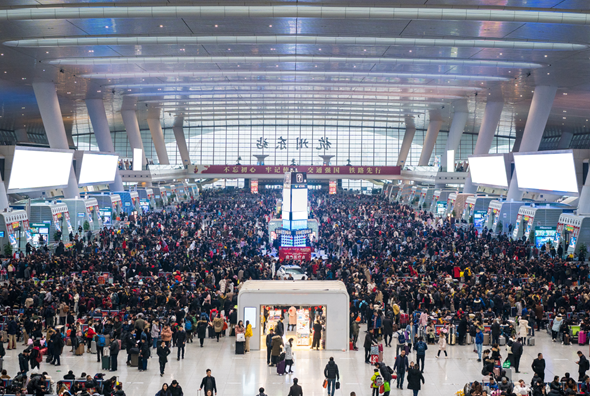
This year’s Spring Festival travel rush is expected to see 9.5 billion cross-regional passenger trips across society. According to estimates by the Data Center of the Ministry of Culture and Tourism, during the 9-day Spring Festival holiday, domestic tourism trips in China reached 596 million, an increase of 95 million compared with the 8-day 2025 Spring Festival holiday; the total domestic tourism expenditure reached 803.483 billion yuan, an increase of 126.481 billion yuan from the same period in 2025. Both the number of tourists and tourism expenditure hit a record high during the holiday, reflecting the strong vitality of China’s cultural and tourism market and the upgrading of people’s holiday consumption needs.
Family Tours: Celebrating the Festival with New Experiences
Traveling with family during the Spring Festival has become an increasingly popular choice for many Chinese people, as it combines holiday relaxation with family reunion. Away from the traditional routine of staying at home or visiting relatives, more families are choosing to explore new places together, adding novelty and joy to the Spring Festival.
In a film and television city in Dezhou, Shandong Province, a family from Shanxi experienced an immersive ancient-style festival. With the city gate slowly opening, performers in ancient armor paraded on horseback, while dancers in Hanfu performed gracefully. The family wandered around the ancient-style scenic spots with green tiles and white walls, enjoying the traditional charm, and watched wonderful performances such as iron flower shows, fireworks and drone shows at night. They also tasted local specialties in nearby food streets, creating warm and unforgettable festival memories.
The popularity of family tours is supported by multiple factors: rising income levels and upgraded consumption concepts have made more families willing to invest in high-quality family experiences; modern transportation represented by high-speed rail has made long-distance travel convenient and efficient; and the increasingly diversified cultural and tourism supply, coupled with smart travel tools such as AI for travel planning, has provided more possibilities for family trips. Various forms of family travel, including smart tourism and customized tours, are emerging, meeting the diverse needs of different families.
Reverse Reunion: Where Family Gathers, There Is the Spring Festival
In addition to family tours, "reverse reunion" has also become a new trend during the Spring Festival. Instead of returning to their hometowns, many people invite their families to their work cities for the holiday, breaking geographical boundaries and focusing on the core of family affection.
A worker in Guangzhou, originally from Heilongjiang, invited his parents and grandmother to spend the Spring Festival in Guangzhou this year. This was the first time he celebrated the festival with his family in his work city after 8 years of employment. He planned the trip carefully: the mild winter in Guangzhou, open scenic spots during the holiday, and convenient catering and accommodation made it an ideal choice for his family. Moreover, reverse air tickets were more cost-effective, allowing the family to save on travel expenses and spend more on cultural experiences and catering.
During the holiday, he acted as a guide for his family, taking them to visit scenic spots such as Baiyun Mountain, the Spring Festival Flower Market, Canton Tower, Yongqingfang and Chen Clan Ancestral Hall, helping them experience the vitality of the city and Lingnan culture. The family gathered around the table to eat traditional dishes, and the warmth of reunion filled the new home, interpreting the meaning of "where family gathers, there is the Spring Festival".
Reverse reunion has achieved a win-win situation of optimized resource allocation and consumption upgrading. It not only avoids the peak price of homebound flights and revitalizes reverse transportation capacity but also converts the saved travel costs into experiential consumption such as cultural tourism and catering. For major cities like Guangzhou, it has activated Spring Festival consumption, with the offline experience needs of the elderly driving the development of time-honored brands, scenic spots and characteristic accommodation, injecting new vitality into the urban economy. Meanwhile, it has also promoted the refinement and humanization of urban governance, with more cities optimizing holiday services such as increasing public transport frequency and extending scenic spot opening hours to welcome "temporary residents".
From traditional family gatherings at home to traveling together and reverse reunion, the way Chinese people celebrate the Spring Festival is constantly evolving, reflecting the rapid development of the economy and society, as well as the people’s pursuit of a better life. This Spring Festival, the booming travel market and diverse reunion methods have not only carried the traditional festival feelings but also shown the vitality of consumption upgrading, laying a solid foundation for the high-quality development of the cultural and tourism industry throughout the year.