World’s Largest Hybrid Pumped Storage Project Enters Peak Construction Phase in Sichuan with AI-powered Smart Worksites
According to People’s Daily Sichuan Channel, the Lianghekou Hybrid Pumped Storage Station, the world’s largest facility of its kind, has reached two pivotal construction milestones. The first main unit has entered full installation work, while the diversion channel of the lower reservoir’s Yagen No.1 Hydropower Station has been fully cut through, marking the high-altitude energy storage hub’s shift into a concentrated construction window.
The scheme sits along the middle reaches of the Yalong River in Yajiang County, Garzê Tibetan Autonomous Prefecture, Sichuan Province, at an altitude close to 3,000 metres. It utilises the Lianghekou Hydropower Station, the province’s largest reservoir by storage capacity, as its upper reservoir, with the Yagen No.1 Hydropower reservoir forming the lower basin. Four 300 MW reversible pump-turbine generating units will be installed, alongside the existing 3,000 MW conventional hydropower capacity already operational at Lianghekou. The combined installed capacity of 4,200 MW makes this the biggest hybrid pumped storage installation anywhere globally.
Engineering constraints at the highland site present complex technical hurdles. The underground powerhouse lies buried 650 metres into mountain rock, with a total cavern length of nearly 200 metres and a vertical height of 60 metres. The newly arrived first reversible unit functions as the station’s core power assembly. Its bespoke wide-head-range pump-turbine delivers a ratio of maximum to minimum water head of 1.55, exceeding the prior domestic technical ceiling of 1.3. Every stage of unit design, manufacturing, on-site assembly and commissioning delivers industry-first technical outcomes for the sector.
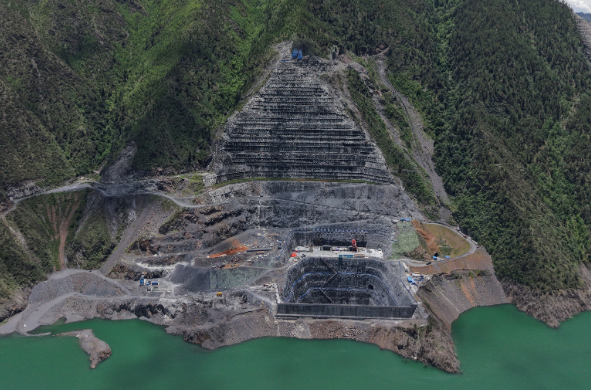
Yagen No.1 Hydropower Station operates as a critical back-regulation auxiliary facility for the pumped storage scheme. Concrete pouring work for flood discharge and energy dissipation structures below the 2,595-metre elevation mark has been finished, and all diversion tunnels are fully open for water flow. Once operational, the auxiliary facility will sharpen water resource scheduling across the wider Yalong River basin, delivering robust operational support ahead of the pumped storage station’s scheduled commissioning in 2028.
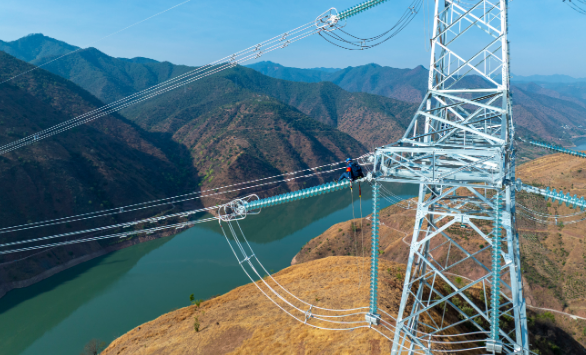
Accelerated construction of the Lianghekou hybrid pumped storage scheme speeds up delivery of the Yalong River integrated wind, solar and hydropower base, advancing completion of the country’s flagship demonstration zone combining hydro, wind, solar, energy storage, green hydrogen production and power-data integration. Centred on the Lianghekou Hydropower complex, the zone incorporates multiple pumped storage stations, cascade hydropower plants, grid-forming storage systems, off-grid green hydrogen facilities, power-data pilot projects and distributed wind and solar arrays, with a total planned installed capacity exceeding 20,000 MW. High-voltage extra-high voltage transmission corridors linking Sichuan and Chongqing will carry consistent green power output to major provincial load centres.
Advanced digital tools, intelligent machinery and custom algorithm frameworks are reshaping construction workflows across the Yalong River basin, boosting safety and efficiency during major infrastructure build phases and extending automated management across the full integrated renewable base.
High-altitude tunnel excavation faces unstable geological strata, intense rock stress and frequent rock burst hazards. State Development & Investment Group deploys fully domestic intelligent construction hardware to mitigate site risks, introducing Tianlong No.1, the country’s first natively integrated smart rock drilling rig. The rig carries self-developed perception hardware and artificial intelligence algorithms to independently survey underground geology, plot travel routes and lock precise drilling coordinates, automating positioning, boring and multi-arm coordinated operations to reduce rock burst safety risks at source. Embedded drill-through geological sensors capture real-time rock formation shifts, adjusting drilling pressure and advance rates dynamically to maintain centimetre-level drilling precision and improve tunnel lining quality. Deployment of the rig brought forward completion of underground powerhouse excavation by three months against baseline schedules.
The intelligent drilling rig operates as part of a coordinated fleet of automated construction machinery, paired with electric loaders, zero-emission heavy haul trucks and AI inspection quadruped robots. A complete low-carbon intelligent construction ecosystem is now fully active on site. Electric haulage plant delivers closed-loop waste rock removal and transportation without on-site carbon emissions, while gas sensor-equipped inspection robots patrol tunnel spaces around the clock to track hazardous gas concentrations. All construction metrics, worker positioning feeds and safety monitoring footage converge within a central intelligent control hub, enabling full visual oversight of the worksite and dynamic hazard oversight across all excavation zones.
At the existing Lianghekou Hydropower Station, China’s first high-altitude cave-based intelligent computing centre runs continuously, acting as a bridge to convert renewable power into digital operational capacity. Multi-dimensional datasets covering meteorology, hydrology, equipment performance, grid demand and market pricing feed into a large-scale prediction model, generating refined forecasts of river inflow, wind and solar generation output, electricity load demand and wholesale market trends. The system raises accuracy in resource forecasting, streamlines power dispatch logic and optimises equipment maintenance cycles, lifting overall utilisation rates of hydro, wind and solar assets and guiding large renewable bases into a new phase of coordinated hardware operation and AI-driven decision-making.
Roll-out of the integrated Yalong River wind, solar and hydropower base progresses steadily, with the integrated pairing of artificial intelligence and multi-source renewable infrastructure forming a practical innovation model for the development of China’s modern power system and the broader shift to low-carbon energy supplies.
热门内容推荐